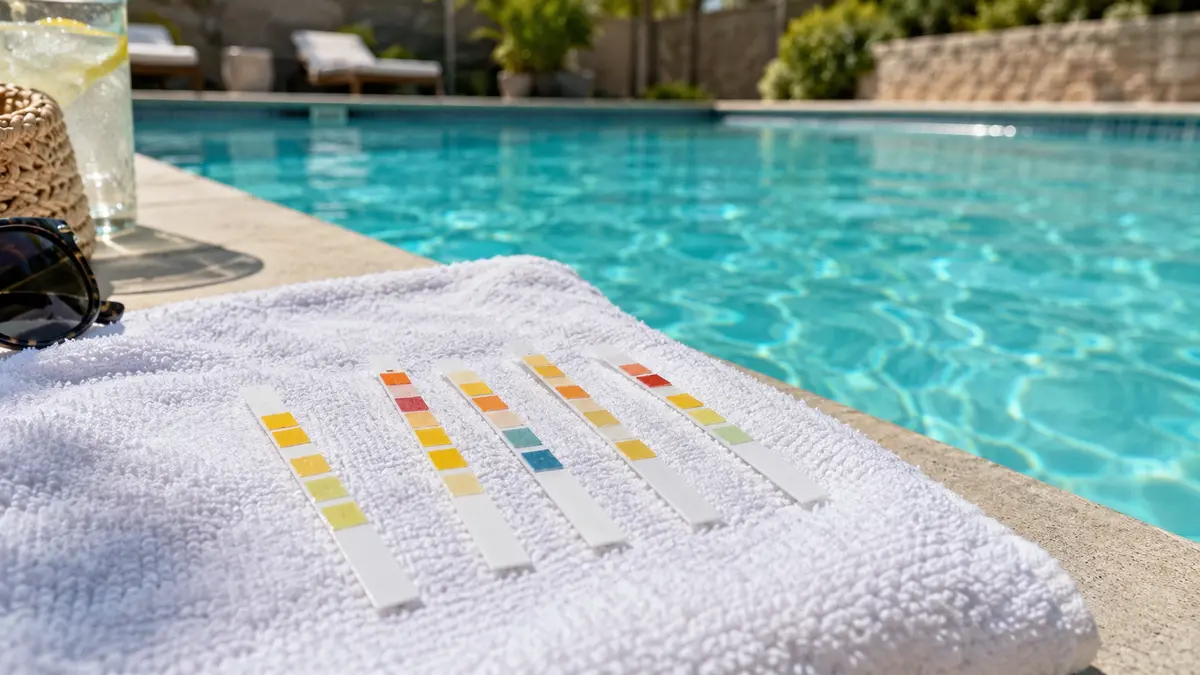
Pool water chemistry levels chart
This chart lists the target range for every reading a residential pool owner is likely to test. Free chlorine is the only reading whose target moves, because it depends on your stabilizer (CYA) level.
| Reading | Ideal range | Notes |
|---|---|---|
| Free chlorine (FC) | Minimum ≈ 7.5% of CYA; target ≈ 11.5% of CYA | CYA 40 → 3 ppm minimum, about 4.6–6.6 ppm target. Never below 1 ppm (2 ppm with CYA) |
| Combined chlorine (CC) | 0 ppm, no more than 0.5 ppm | Higher means chloramines; shock to clear |
| pH | 7.2–7.8 (7.4–7.6 best) | Affects comfort, chlorine strength and scaling |
| Total alkalinity (TA) | 60–120 ppm | 80–120 common for plaster; salt pools often 60–80 |
| Calcium hardness (CH) | 200–400 ppm typical | Plaster, gunite and pebble often 250–450; vinyl and fiberglass can run lower |
| Cyanuric acid (CYA) | 30–50 ppm (chlorine pools) | 60–80 ppm for salt pools; none in hot tubs |
| Salt | Per your chlorinator manual | Often about 2,700–3,400 ppm; many models target ~3,200 |
| Phosphates | No required target (optional) | Only matters if chlorine is not kept in range |
| Metals (copper, iron) | Undetectable | Any reading risks stains when chlorine rises |
| Total dissolved solids (TDS) | No hard limit | Track the trend; salt pools read high by design |
| Saturation index (LSI) | −0.3 to +0.3 | Combines pH, calcium, alkalinity and temperature |
| Water temperature | Not a target | Warmer water uses more chlorine and scales more easily |
Ranges are guidelines for residential pools. Public pools follow state and local health codes, which may set different limits.
Free chlorine: why the target depends on CYA
Free chlorine should be at least 7.5% of your cyanuric acid level, with about 11.5% of CYA as the everyday target. Stabilizer protects chlorine from sunlight but holds part of it in reserve, so the more CYA you have, the more FC you need for the same germ-killing power.
Worked example: a pool with 50 ppm CYA has a minimum FC of 50 × 0.075 = 3.75 ppm and a target of 50 × 0.115 ≈ 5.75 ppm. Shock level is 40% of CYA, or 20 ppm. This FC/CYA relationship was popularized by the Trouble Free Pool community and is what our calculators use.
The CDC sets the floor for home pools at a free chlorine level of at least 1 ppm, or at least 2 ppm when cyanuric acid is used, with pH between 7.0 and 7.8 (CDC home pool water treatment guidance). Those are health minimums. In an outdoor stabilized pool, the FC/CYA guideline keeps you well above them and also prevents algae.
Combined chlorine: what CC tells you
Combined chlorine should be 0 ppm and never above 0.5 ppm. CC is chlorine that has already reacted with sweat, urine and other waste. It causes the strong “chlorine” smell and eye irritation that people blame on too much chlorine.
Combined chlorine is calculated as total chlorine minus free chlorine. If CC stays above 0.5 ppm, raise FC to shock level (40% of CYA) and hold it until CC drops.
pH: the comfort and balance number
Keep pH between 7.2 and 7.8, ideally 7.4 to 7.6. Low pH stings eyes, etches plaster and corrodes metal. High pH weakens chlorine and pushes calcium out of solution as scale.
pH tends to rise on its own in most pools, especially with salt cells, fountains and fresh plaster. Lower it with muriatic acid (31.45% or half-strength 14.5%) or dry acid (sodium bisulfate). Raise it with soda ash or borax. Acid demand depends on alkalinity and CYA, so add about half the calculated amount, circulate for 30 minutes, and retest.
Total alkalinity: the pH buffer
Total alkalinity should sit between 60 and 120 ppm. TA resists pH change. Too low and pH swings with every rain shower; too high and pH keeps drifting upward, so you add acid constantly.
Plaster pools often do best at 80–120 ppm. Salt pools often run 60–80 ppm, because salt cells raise pH and lower TA slows that rise. Baking soda raises TA (1.4 lb raises 10,000 gallons by 10 ppm). Lowering TA takes acid plus aeration over several rounds.
Calcium hardness by surface type
Calcium hardness depends mainly on your pool surface. Plaster, gunite and pebble finishes contain calcium, so water low in calcium will slowly dissolve them. Vinyl and fiberglass surfaces have no calcium to lose, so they tolerate lower hardness.
| Surface | Typical CH target | Main risk when CH is wrong |
|---|---|---|
| Plaster, gunite, pebble | 250–450 ppm | Too low: etching and pitting. Too high: scale |
| Vinyl liner | Lower is acceptable; 200–400 ppm is fine | Too high: cloudy water and scale on fittings |
| Fiberglass | Lower is acceptable; 200–400 ppm is fine | Too high: scale and staining on the gel coat |
Calcium chloride raises CH: about 1.2 lb of 77–80% flakes raises 10,000 gallons by 10 ppm. The only practical way to lower CH is to replace water with softer fill water.
Cyanuric acid: chlorine pools vs salt pools
Keep CYA at 30–50 ppm in a chlorine pool and 60–80 ppm in a salt pool. Salt cells make chlorine continuously, and the higher CYA protects it through the day. Indoor pools need little or no CYA, and the CDC advises against using it in hot tubs.
CYA builds up when you use trichlor tablets or dichlor, because both add stabilizer with every dose. It does not break down, so the fix for high CYA is a partial drain: to go from 100 to 50 ppm, replace half the water.
Salt, phosphates, metals and TDS
Salt. Follow the range in your chlorinator’s manual. Many cells want about 3,200 ppm; low salt reduces output and can shorten cell life, while very high salt can trigger alarms and adds to corrosion around stone and metal.
Phosphates. These are optional to test. They feed algae, but proper FC for your CYA keeps algae from growing regardless of phosphate level.
Metals. Copper and iron should be undetectable. Common sources are well water, copper algaecides, ionizers and heater heat exchangers corroded by low pH. Metals stain plaster and can turn water green or brown when chlorine is raised.
TDS. Total dissolved solids rise as water evaporates and chemicals are added. There is no hard limit for home pools; a rising trend alongside hard-to-explain problems is a reason to replace some water.
Temperature and the saturation index
Temperature is not something you target, but it changes the balance. Warm water uses chlorine faster and is more likely to form scale, because the saturation index rises with temperature. Cold water is more aggressive toward plaster.
The saturation index combines pH, calcium, alkalinity, CYA and temperature into one number; −0.3 to +0.3 is balanced. To dose any correction for your gallons, use the pool chemical calculator, and if you are unsure of your volume, check it with the pool volume calculator. For daily routine, seasonal care and when to drain, see our pool water care guide.
Safety when adjusting levels
Add one chemical at a time with the pump running, and let it circulate before adding the next. Always add chemicals to water, never water to chemicals. Keep acid and chlorine apart in storage and never mix products. Wear gloves and eye protection, and follow the product label.