What does cyanuric acid do in a pool?
Cyanuric acid (CYA), sold as pool stabilizer or conditioner, protects chlorine from sunlight. Unstabilized chlorine in an outdoor pool can lose most of its strength in a few hours of direct sun. With CYA in the water, chlorine lasts far longer, so you add less of it and your free chlorine (FC) reading holds through the day.
CYA works by loosely binding chlorine. The bound chlorine is shielded from UV, then releases back into the water as the active chlorine is used up. A 2024 review in Frontiers in Public Health describes how cyanuric acid protects chlorine from sunlight-driven breakdown and notes that it does not decompose or leave the water on its own. That second point explains most CYA problems: it only ever goes up unless water is replaced.
Sunlight protection vs. chlorine holding: what is the trade-off?
The same binding that protects chlorine also slows it down. The more CYA you have, the more of your free chlorine is held in reserve and the less is active at any moment. That is why the free chlorine you need scales with CYA: roughly 7.5% of CYA as a minimum and about 11.5% as a daily target, the relationship the calculators on this site use.
| CYA (ppm) | Sun protection | Minimum FC | Practical note |
|---|---|---|---|
| 0 | None | 1 ppm | Fine indoors; chlorine burns off fast outdoors |
| 30–50 | Good | 2.3–3.8 ppm | Typical range for liquid chlorine and tablet pools |
| 60–80 | Strong | 4.5–6 ppm | Typical range for salt pools |
| 100+ | Strong | 7.5+ ppm | FC demand gets hard to keep up with; consider diluting |
Pick a target, then keep it there. Too little CYA wastes chlorine to the sun. Too much forces you to carry high FC levels and makes shocking expensive, because the shock level is about 40% of CYA.
How to use the cyanuric acid calculator
- Enter your pool volume in gallons. If you are not sure, find your gallons first with the pool volume calculator.
- Enter your current CYA from a recent test. For a freshly filled pool with no stabilized chlorine, use 0.
- Enter your target: 30–50 ppm for most chlorine pools, 60–80 ppm for salt pools.
- Read the result. If your target is higher, you get ounces of stabilizer. If it is lower, you get the percentage and gallons of water to replace.
The table above shows the dose for a 10 ppm rise at common pool sizes, so you can sanity-check the result. To balance chlorine, pH and alkalinity in the same visit, use the pool chemical calculator.
What is the formula for adding stabilizer?
Ounces of stabilizer = ppm increase × gallons × 3.785 ÷ 1,000 ÷ 28.35. In plain terms, that works out to about 13.4 oz of 100% cyanuric acid per 10 ppm per 10,000 gallons (about 380 g per 37,854 L).
Worked example. A 15,000-gallon pool tests at 10 ppm CYA, and you want 40 ppm.
- Increase needed: 40 − 10 = 30 ppm
- Dose: 13.35 oz × (15,000 ÷ 10,000) × (30 ÷ 10) = about 60 oz
- That is 3 lb 12 oz (about 1.7 kg) of granular stabilizer
If you are setting up a new salt pool at 20,000 gallons and going from 0 to 70 ppm, the same math gives about 11 lb 11 oz.
How does CYA build up from trichlor and dichlor?
Stabilized chlorine products carry CYA with every dose. Trichlor tablets add about 0.6 ppm CYA for each 1 ppm of free chlorine they release; dichlor granules add about 0.9 ppm. Liquid chlorine, cal-hypo and salt chlorinators add none.
| Daily chlorine source | CYA added per 1 ppm FC | CYA added in 30 days at 3 ppm FC/day |
|---|---|---|
| Trichlor tablets (90%) | ~0.6 ppm | ~55 ppm |
| Dichlor granules (56%) | ~0.9 ppm | ~82 ppm |
| Liquid chlorine / bleach | 0 | 0 |
| Cal-hypo | 0 | 0 (adds calcium instead) |
| Salt chlorinator | 0 | 0 |
A pool that starts the summer at 40 ppm and runs only on tablets can pass 100 ppm by midseason. If your CYA keeps climbing, switch your daily chlorine to liquid and keep tablets for vacations.
How do you raise CYA safely?
Granular stabilizer dissolves slowly, and undissolved granules sitting on the floor can stain or damage some surfaces. Use one of these methods:
- Skimmer sock method. Pour the measured dose into a nylon sock or fine mesh bag, tie it off, and hang it in the skimmer basket or in front of a return jet. Squeeze it gently once a day until it is empty.
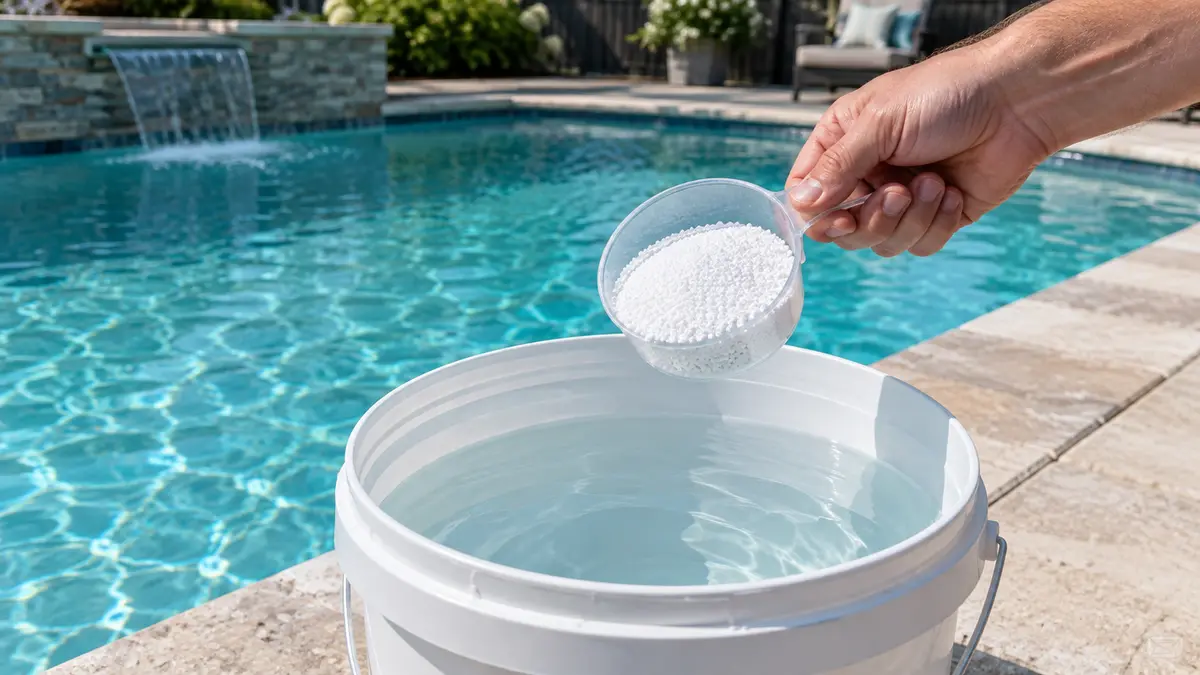
- Slow dissolve in a bucket. Fill a clean bucket with warm water first, then add the stabilizer and stir. Pour the slurry slowly in front of a return jet while the pump runs. Always add chemical to water, never water to chemical.
- Liquid stabilizer. Pre-dissolved products exist. They are less concentrated than dry granules, so dose by the label, not by this calculator’s ounce figure.
Keep the pump running and do not backwash or clean a cartridge for several days, or you will throw away undissolved stabilizer. Cyanuric acid is a weak acid, so expect pH and total alkalinity to drop slightly; recheck pH after it dissolves. Wear gloves and eye protection and keep stabilizer stored apart from chlorine and acid.
How do you lower cyanuric acid?
The reliable way to lower CYA is to replace water. The share to replace = 1 − target ÷ current, assuming your fill water has no CYA.
Worked example. CYA tests at 90 ppm and you want 50 ppm: 1 − 50 ÷ 90 = 0.44, so replace about 44% of the water. In a 20,000-gallon pool, that is about 8,900 gallons.
Practical tips:
- Drain and refill in stages, retesting between rounds. Rain and earlier top-offs may already have diluted some CYA.
- Do not drain an inground pool completely or leave it low in high groundwater conditions. If in doubt, follow your builder’s guidance.
- Vinyl liners can shrink or shift when the water drops too far; keep the water above the bottom of the liner and refill promptly.
How do you test CYA accurately?
Most home kits use a turbidity test: a melamine reagent reacts with cyanuric acid and clouds the sample, and you read the level by how far down the tube a black dot disappears. It is a useful test with real limits.
- The range is narrow. Most kits read reliably only from about 20–30 ppm up to about 100 ppm. Below that, the dot never disappears; above it, the scale runs out.
- Dilute high readings. If CYA reads at the top of the scale, mix the pool sample 50/50 with tap water that has no CYA, test again, and double the result.
- Lighting matters. Read in steady, even daylight with your back to the sun. Harsh glare and dim indoor light both make the dot harder to judge, so use the same spot each time.
- Temperature matters. Run the test at roughly room temperature; very cold samples can skew the result.
- Results are approximate. Treat one reading as an estimate and look at the trend over several tests. Test strips are especially rough for CYA.
Never decide to drain based on a single strip reading. Confirm with a drop-style kit first.
What are the most common CYA mistakes?
- Adding stabilizer every time you add chlorine. If you use tablets, you are already adding CYA.
- Retesting too soon. Undissolved stabilizer reads as missing, which leads to doubling the dose.
- Ignoring the FC link. Raising CYA without raising your daily free chlorine target lets algae in.
- Using CYA indoors. Without sunlight it adds no benefit and raises the chlorine you need.
For the full set of target ranges in one place, see ideal pool water chemistry levels. The constants behind this calculator are listed on our methodology page.