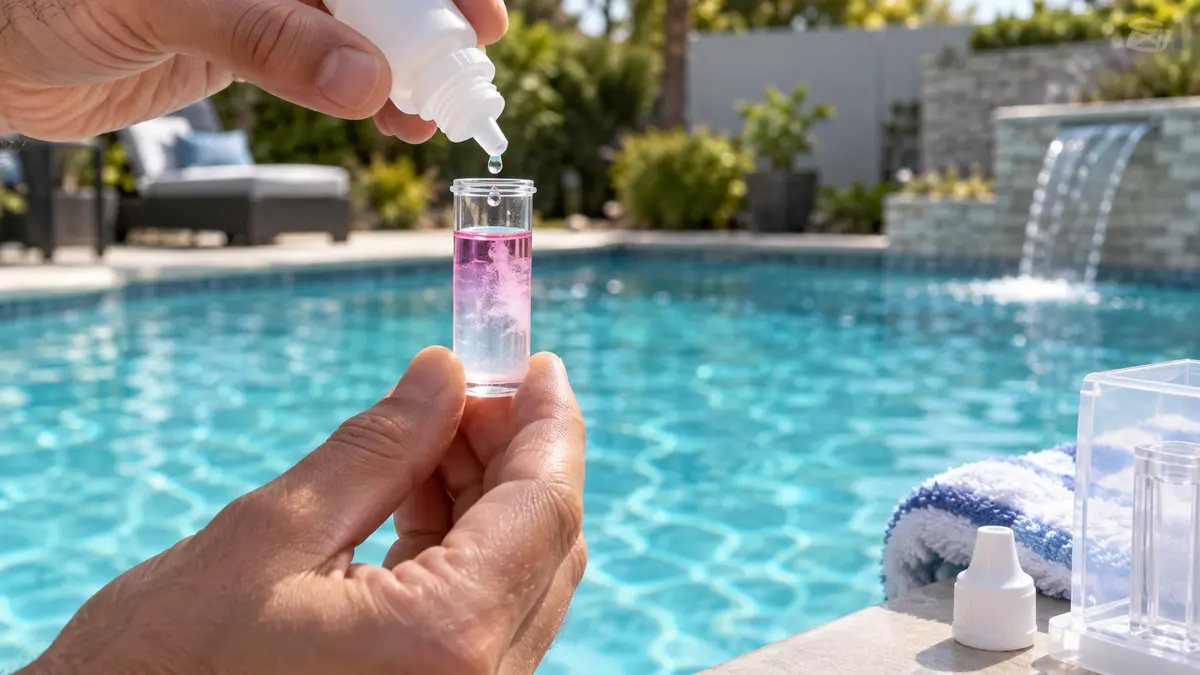
What does a chlorine CYA chart show?
A chlorine CYA chart shows how much free chlorine (FC) your pool needs for its stabilizer (cyanuric acid, CYA) level. It gives three numbers for each CYA reading: the minimum FC that keeps algae from getting started, a target range to dose up to every day, and the shock level used to clear algae or cloudy water.
| Column | Share of CYA | What it means for you |
|---|---|---|
| Minimum FC | ~7.5% | Never let FC fall below this. Below it, algae can start growing. |
| Target FC | ~11.5% (plus a 2 ppm working range) | Dose up to this range each day so you stay above the minimum. |
| Shock FC | ~40% | Hold here to kill algae and clear water, until the pool tests clean. |
The full chart for common CYA levels is in the table above, and the calculator gives exact numbers for any reading.
Why does free chlorine need to rise with CYA?
Stabilizer protects chlorine from sunlight by holding most of it in a bound, reserve form. Only a small share is the active form that kills germs and algae at any moment. The more CYA in the water, the larger the bound share, so you need more total free chlorine to keep the active amount the same.
That is why a single “keep chlorine at 1–3 ppm” rule fails for many outdoor pools. At 20 ppm CYA, 2 ppm FC works. At 70 ppm CYA, 2 ppm leaves too little active chlorine, and algae gets a foothold even though the test looks “normal.”
Where does the FC/CYA relationship come from?
The percentages on this chart follow the FC-to-CYA relationship popularized by the Trouble Free Pool community, which publishes its own free chlorine and cyanuric acid chart and explanation. Their published chart rounds values to whole numbers and lists slightly lower targets for salt pools, so you will see small differences from ours. Pool Water Calculator is independent; we apply the same percentages exactly so the chart, the calculator and our other tools always agree. The constants are listed on our methodology page.
How to use the chart
- Test CYA. It changes slowly, so testing every few weeks is usually enough, more often if you use trichlor tablets or dichlor, which add CYA with every dose.
- Enter your CYA in the calculator above (tick the salt box if you have a salt chlorinator).
- Note your minimum, target and shock numbers.
- Test FC daily in season, ideally at the same time each day.
- Compare your reading to the three numbers and act on the table below.
| Your FC reading | What to do |
|---|---|
| At or above shock level | No chlorine needed. Keep swimmers out until it drops toward target, unless you are treating algae. |
| Between target and shock | No chlorine today. It will drift down into the target range. |
| Within the target range | No action, or top up to the high end if you dose once a day. |
| Between minimum and target | Add chlorine to reach the top of the target range. |
| Below minimum | Dose to target now, then watch for algae. If water is cloudy or green, raise FC to the shock level and hold it. |
To turn “add chlorine” into ounces, use the pool chemical calculator, or the rule of thumb of 12.8 fl oz of 10% liquid chlorine per 1 ppm per 10,000 gallons.
How do you use the chart for daily dosing?
Dose in the evening up to the top of your target range, so the chlorine lost to sun the next day still leaves you above the minimum. The width of the target range (about 2 ppm) only works if your daily loss is smaller than the gap between the top of the range and the minimum.
Worked example. A 15,000-gallon pool runs 40 ppm CYA. The chart gives a 3 ppm minimum and a 4.6–6.6 ppm target.
- Evening test: FC is 3.5 ppm. Dose up to about 6.5 ppm: a 3 ppm rise.
- 10% liquid chlorine: 12.8 fl oz × 3 × 1.5 = about 58 fl oz (1.7 L).
- If the pool loses 3 ppm a day, tomorrow evening it reads about 3.5 ppm again, still above the 3 ppm minimum.
If your pool loses more than about 3–4 ppm a day at this CYA, the target range is too narrow for once-a-day dosing. Either dose twice a day, add an automatic feeder, use a pool cover, or raise CYA a little (and your FC targets with it). Find your gallons for any of these calculations with the pool volume calculator.
How are salt pools different?
The FC-to-CYA percentages do not change for salt pools. What changes is where on the chart they usually sit and how FC behaves through the day.
- Higher CYA is common. Salt pools typically run 60–80 ppm CYA. The extra stabilizer protects the chlorine the cell makes, which means the cell can run fewer hours. At 70 ppm CYA, the chart gives a 5.3 ppm minimum, an 8.1–10.1 ppm target and a 28 ppm shock level.
- Smaller daily swings. A salt cell adds chlorine whenever the pump runs, so FC does not drop and spike the way it does with once-a-day liquid doses. Many salt pool owners can hold FC toward the lower part of the target range for that reason.
- Adjust the cell, not the jug. Day to day, you change cell output percentage or pump run time to stay in range. You still use liquid chlorine or the cell’s boost mode when you need to reach the shock level, because most cells cannot raise FC that fast.
Your chlorinator’s manual governs salt level and cell settings. Use this chart for the chlorine level, and the manual for how to run the equipment.
What happens at very high CYA?
Above about 90 ppm CYA, the numbers become hard to live with: a 100 ppm CYA pool needs 7.5 ppm FC just to hold the minimum and 40 ppm to shock. If you end up there, lower CYA by replacing part of the water (share to replace = 1 − target ÷ current), then switch to an unstabilized chlorine source such as liquid chlorine so it does not climb again. The common target ranges for every reading are summarized in ideal pool water chemistry levels.
What are the most common chart mistakes?
- Using an old CYA reading. Tablet pools gain CYA every week; the chart is only as good as your last test.
- Reading strips at high FC. Coarse color blocks can make 6 ppm and 10 ppm look alike.
- Dosing in the morning. Sunlight spends the dose before evening; dose at dusk.
- Stopping a shock early. A shock is finished only when combined chlorine is 0.5 ppm or less, the water is clear, and overnight FC loss is 1 ppm or less.
Safety note: add chlorine to the pool with the pump running, never mix chlorine with acid or with other chlorine products, and wear gloves and eye protection when handling either.