How does a salt chlorinator work?
A salt chlorinator makes chlorine from salt dissolved in your pool water. Water flows through a cell of coated metal plates, and a low-voltage current converts chloride into free chlorine. That chlorine sanitizes the pool, then breaks back down into chloride, ready to be converted again. The salt is recycled, not consumed.
This is why a salt pool is a chlorine pool. You still test free chlorine and keep it in range; the difference is that the chlorinator produces it every time the pump runs, instead of you pouring it in. Three things control how much chlorine you get each day:
- Salt level. Too little salt and the cell produces less chlorine or shuts down.
- Output setting. Most systems let you set a percentage of maximum output.
- Pump run time. The cell only works when water flows through it.
Two side effects are worth knowing. Salt pools tend to see pH drift upward, so many owners run total alkalinity lower (often 60–80 ppm) to slow the rise. And the cell plates collect calcium scale if the water is scale-forming, so balanced water matters more than in a liquid-chlorine pool.
What salt level does a salt pool need?
Use the ideal salt level printed in your chlorinator’s manual. Ranges differ by brand and model, so the manual beats any general rule, including ours. As one example, Hayward’s AquaRite owner’s manual gives an ideal range of 2,700–3,400 ppm with 3,200 ppm as optimal, warns that low salt reduces chlorine output, and says high salt can shut the unit down and starts to taste salty at about 3,500–4,000 ppm.
| Salt reading vs. your manual | What it means | What to do |
|---|---|---|
| Well below range | Cell makes little or no chlorine; may show a low-salt warning | Add salt with the calculator above |
| Slightly below ideal | Output reduced; cell works harder | Top up to the ideal level |
| At ideal | Normal operation | Test monthly and after big water changes |
| Above range | Possible high-salt warning or shutdown; salty taste | Replace part of the water |
That is about 3.2 grams of salt per liter at 3,200 ppm, roughly a tenth of the salt in seawater. Most people barely notice it.
How to use the pool salt calculator
- Enter your pool volume in gallons. If you are not sure, measure and use the pool volume calculator first. A 10% error in gallons is a 10% error in salt.
- Enter your current salt level. Use 0 for a freshly filled pool. For an existing pool, test with strips or a meter rather than trusting the cell’s display alone.
- Enter your target salt level from your chlorinator’s manual (often around 3,000–3,400 ppm).
- Choose your bag size: 40 lb, 50 lb, or 20 kg (44 lb).
- Read the result in pounds, kilograms, and bags rounded up to the nearest half bag.
The table above shows how much salt it takes to bring common pool sizes from 0 to 3,200 ppm.
What is the formula for adding salt?
Pounds of salt = (target ppm − current ppm) × gallons × 8.34 ÷ 1,000,000.
The 8.34 is the weight of a US gallon of water in pounds, so the formula simply finds the weight of your water and takes the parts-per-million share of it. In metric it is even simpler: kilograms of salt = ppm increase × liters ÷ 1,000,000, because 1 ppm is 1 mg per liter.
Rule of thumb: about 8.3 lb of salt raises 10,000 gallons by 100 ppm.
Worked example 1, topping up. An 18,000-gallon pool reads 2,600 ppm and the manual says 3,200 ppm.
- Increase: 3,200 − 2,600 = 600 ppm
- Salt: 600 × 18,000 × 8.34 ÷ 1,000,000 = about 90 lb (41 kg)
- Bags: 90 ÷ 40 = 2.25, so buy three 40 lb bags and keep the leftover dry
Worked example 2, new pool. A 15,000-gallon pool is freshly filled with no salt.
- Salt: 3,200 × 15,000 × 8.34 ÷ 1,000,000 = about 400 lb (182 kg)
- Bags: 10 forty-pound bags
How do you add salt to a pool?
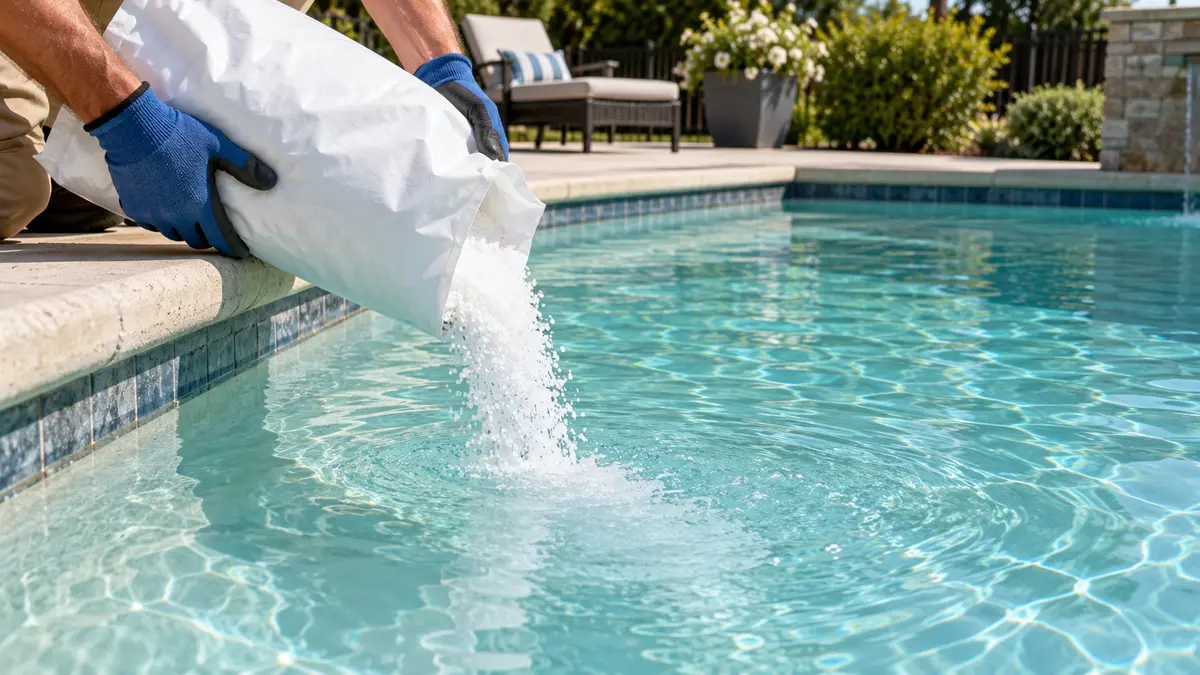
Add salt directly to the pool water with the pump running, brush it to help it dissolve, and give it a day to mix before you retest.
- Test first. Pools that have used liquid chlorine for a while already contain some salt, because sodium hypochlorite leaves salt behind. Enter the real starting level.
- Wait on new plaster. Fresh plaster needs to cure before salt goes in. Hayward’s manual says to wait 10–14 days; follow your builder if they give a longer window.
- Turn the chlorinator off (or set output to zero) while the salt dissolves, so the cell is not running in uneven water.
- Run the pump and pour salt in the shallow end or around the perimeter, not into the skimmer. Spread it out so it does not pile up in one spot.
- Brush the floor to break up piles and speed dissolving. Do not let undissolved salt sit for hours on any surface.
- Add about two-thirds of the dose first. Run the pump about 24 hours, with suction from the main drain if you can, then retest.
- Add the rest if needed, circulate again, and turn the cell back on once the reading is in range. Some cell displays take up to 24 hours to update.
Bag salt is heavy. Lift with your legs, cut the bag open near the water, and pour low to avoid splashing salt onto the deck or coping.
What kind of salt should you use in a pool?
Use plain sodium chloride that is at least 99% pure, with no iodine, anti-caking agents, or other additives. Hayward’s manual, for example, specifies salt greater than 99% pure and rules out rock salt, iodized salt, and salt with yellow prussiate of soda or other anti-caking additives.
| Salt type | Good for pools? | Notes |
|---|---|---|
| Bagged “pool salt” (99%+ NaCl) | Yes | Made for this job; check the label for purity and additives |
| Solar salt (evaporated by sun) | Yes, if 99%+ pure | Coarse crystals; dissolves well with brushing |
| Mechanically evaporated / food-grade salt | Yes | Very pure, fine grain, dissolves fastest |
| Water-softener pellets or crystals | Acceptable if additive-free | Pellets dissolve slowly; avoid softener salt with rust or iron removers |
| Rock salt | No | Contains insoluble minerals and dirt that can stain and cloud water |
| Iodized table salt | No | Iodine and additives are unwanted in pool water |
| Salt with anti-caking agents | No | Additives can discolor water and surfaces |
Price per bag varies a lot by store and season. What matters is purity and additives, not the word “pool” on the bag.
How do you test pool salt levels?
Test salt with a dedicated salt test, then compare it to your chlorinator’s own reading. Do not rely on the cell display alone, because it estimates salt indirectly and can drift.
| Method | How it works | Strengths | Watch out for |
|---|---|---|---|
| Salt test strips (titrator type) | A wicking strip changes color; you read a number off a chart | Cheap, simple, good enough for routine checks | Read at the exact time stated; check the expiry date |
| Digital salt meter | Measures conductivity and converts it to salt | Fast; repeatable | Needs calibration; readings shift with temperature |
| Drop titration kit | Count drops of reagent until a color change | Accurate when done carefully | Takes a few minutes; follow sample size exactly |
| Chlorinator display | The control box estimates salt from cell conductivity and temperature | Always available | Can read low as plates scale or age; can lag a day after adding salt |
If the cell reports low salt but a strip or meter says your level is fine, do not add salt yet. Inspect and clean the cell first; scale on the plates is a common cause of a false low reading.
Why does pool salt “disappear”?
Salt does not evaporate, and the chlorinator does not use it up. When water evaporates, the salt stays behind, so evaporation alone makes the reading go up slightly until you top off with fresh water. Hayward’s manual makes the same point: salt is lost through splashing, backwashing, or draining after rain, not evaporation.
The usual reasons your salt reading drops:
- Rain dilution. Heavy rain adds fresh water; if the pool overflows or you lower the level afterward, salt leaves with that water.
- Backwashing and draining. Every gallon sent to waste takes salt with it.
- Splash-out and drag-out. Swimmers and cannonballs carry water out all season.
- Leaks. A steady salt loss without rain or backwashing can point to a leak.
- A dirty or aging cell. The salt may be fine and the display wrong; test independently.
Stabilizer leaves the same way, so when salt drops, check CYA too. Salt pools typically run 60–80 ppm CYA so the chlorine the cell makes lasts through the day.
What if your salt level is too high?
There is no product that removes salt. The only fix is to drain part of the water and refill with fresh water, and the share to replace depends on how far over you are. Our guide on how to lower pool salt level calculates the exact percentage and gallons, with tips for draining safely.
How do you convert an existing pool to salt?
You can switch most chlorine pools to a salt system without draining. The work is mostly in sizing the cell and preparing the water.
- Choose a cell. Cells are rated by pool size and pounds of chlorine per day. Our salt chlorinator sizing calculator estimates your daily chlorine demand and the cell size to match it.
- Check your surroundings. Hayward’s manual recommends consulting a stone specialist about natural stone coping or decking around a saline pool. Ask about metal components too.
- Plan the plumbing. Cells usually go on the return line after the filter, heater, and other equipment. Follow your cell’s installation instructions and local codes; electrical work belongs with a qualified electrician.
- Test and balance the water. Get pH, total alkalinity, calcium hardness, and CYA into range first. Raise CYA toward 60–80 ppm.
- Add salt to the level in your new cell’s manual using the calculator above, starting from your tested current level.
- Start the cell at a moderate setting and adjust over a few days based on free chlorine tests. Hayward suggests starting around 50% output and adjusting from there.
For the full set of target ranges, including free chlorine for your stabilizer level, see ideal pool water chemistry levels.
What are the most common pool salt mistakes?
- Guessing gallons. Salt is cheap but slow to remove; overshooting means draining.
- Trusting the cell display alone. Confirm with a strip or meter before adding salt.
- Dumping all the salt at once. Add about two-thirds, retest, then finish.
- Pouring salt into the skimmer. It sends a slug of very salty water through the pump, filter, and cell.
- Using rock or table salt. Impurities and additives cause stains and cloudiness.
- Forgetting CYA. Salt and stabilizer drop together after rain and draining.
Safety note: salt itself is mild, but salt pools still use chlorine, acid, and other chemicals. Add chemicals to water, never water to chemicals, never mix chlorine with acid, and wear gloves and eye protection. Every formula and constant behind this calculator is listed on our methodology page.