How do you lower salt in a pool?
The only way to lower salt in a pool is dilution: drain some water, refill with fresh water, and let it mix. Salt does not evaporate, break down, or get trapped by the filter. Hayward’s AquaRite manual states this plainly: partially drain the pool and refill with fresh water. The calculator above tells you how much to drain.
Because you are diluting, the math depends only on the ratio of where you are to where you want to be, not on the size of the overshoot in pounds.
How to use the calculator
- Enter your pool volume in gallons. If you are unsure, check it with the pool volume calculator.
- Enter your current salt level from a reliable test (see below).
- Enter your target salt level from your chlorinator’s manual.
- Read the result: the share of water to replace, the gallons that represents, and the pounds of salt it removes.
The table above shows the share to replace for common starting levels when you are aiming for 3,200 ppm.
What is the formula for lowering salt?
Share of water to replace = 1 − target ppm ÷ current ppm, assuming your fill water has essentially no salt. Gallons to replace = share × pool gallons.
Worked example. A 20,000-gallon pool reads 4,200 ppm and the manual’s ideal is 3,200 ppm.
- Share: 1 − 3,200 ÷ 4,200 = 0.238, so about 24%
- Gallons: 0.238 × 20,000 = about 4,760 gallons (18,000 L)
- Salt removed: (4,200 − 3,200) × 20,000 × 8.34 ÷ 1,000,000 = about 167 lb
If your fill water contains salt. Some water sources, including softened or brackish well water, carry measurable salt. Then use: share = (current − target) ÷ (current − fill level). Going from 4,500 to 3,400 ppm with 200 ppm fill water needs about 26% instead of 24%.
Should you confirm the reading before draining?
Yes. Draining is slow, wastes water, and cannot be undone, so confirm the number first. Salt cells estimate salt from conductivity and temperature, and their readings can drift.
- Test with two methods. Compare a salt strip or a calibrated meter with the cell’s display.
- Check the date of your last big change. If you recently added salt, wait a full day of circulation; undissolved salt makes readings jump around.
- Consider evaporation. In hot, dry weather, the water level drops and the salt reading rises. Topping up to the normal level with fresh water may bring it back without any draining.
- Look at your manual’s limit. A reading slightly above ideal but still inside the manual’s range does not require action.
How should you drain the pool safely?
Drain in stages rather than all at once. Take out about half the calculated amount, refill, circulate 24 hours, retest, and repeat only if needed. You often need less than the math says, because rain and top-offs dilute along the way.
| Pool type | Main risk when lowering the water | Precaution |
|---|---|---|
| Plaster / gunite | Groundwater pressure on an empty or near-empty shell | Partial drains only; never empty it yourself, especially after heavy rain |
| Fiberglass | Shell can lift or bulge if drained too low | Keep water well up the walls; follow the manufacturer’s guidance |
| Vinyl liner (inground) | Liner can shrink, shift, or pull out of its track | Avoid deep drains; refill promptly |
| Above-ground | Liner shifting and wall stress | Keep enough water to hold the liner in place; refill the same day |
Ways to remove water:
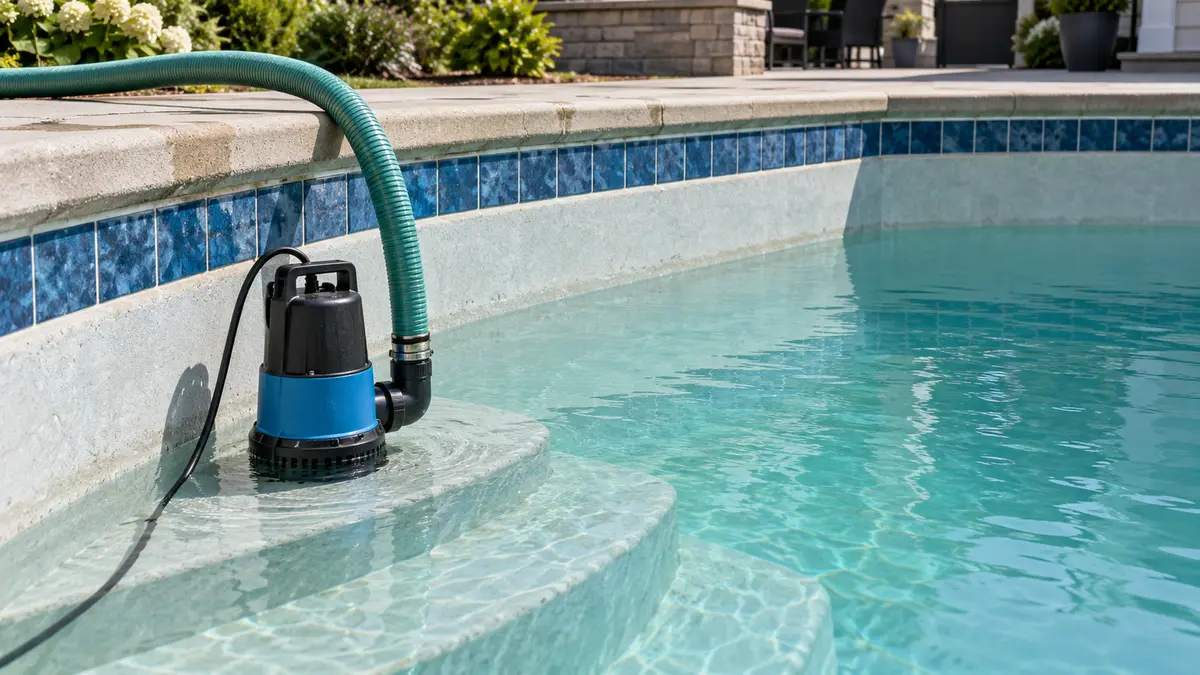
- Submersible utility pump with a discharge hose. Simple and independent of your pool equipment.
- Filter “waste” or “drain” setting on a multiport valve, with the pump pulling from the main drain.
- Garden hose siphon for small amounts.
Practical tips:
- Turn the salt cell off before you start.
- Once the water drops below the skimmer, stop the pump or close the skimmer line so it does not run dry.
- Check local rules before discharging. Many areas restrict where pool water can go, and salt water can damage lawns, garden beds, and some plants.
- Never leave a pump running unattended for long periods; it is easy to overshoot.
What should you do after refilling?
Refilling dilutes everything, not just salt. Run the pump for at least a full day, then:
- Retest salt. If it is within your manual’s range, stop.
- Retest stabilizer (CYA). It dropped by the same share. Salt pools usually run 60–80 ppm.
- Retest calcium hardness and total alkalinity, especially if your fill water is soft.
- Check pH and free chlorine, then turn the salt cell back on.
Use the pool salt calculator if you overshoot on the low side and need to add a little back. For every target range in one place, see ideal pool water chemistry levels.
Why did my salt level get too high?
Knowing the cause stops it from happening again.
| Cause | How it happens | Prevention |
|---|---|---|
| Guessed pool volume | Salt dose based on too few gallons | Measure your pool; recalculate before adding salt |
| Trusting a low cell reading | Scaled or aging plates read low, so salt gets added | Confirm with strips or a meter; clean the cell |
| Adding the full dose at once | No chance to retest before overshooting | Add about two-thirds, circulate, retest |
| Evaporation without refilling | Salt concentrates as water leaves | Top off with fresh water before testing |
| Years of liquid chlorine and acid | Both leave salt behind as they react | Normal; just test before adding salt |
What are the most common mistakes when lowering salt?
- Draining the full amount in one go. Staged drains with retests avoid overshooting.
- Draining an inground pool too far. Groundwater and liner damage are expensive problems.
- Forgetting the cell. Leaving it on while water levels and salt swing can trigger errors.
- Skipping the rebalance. Low CYA after a drain makes chlorine disappear in the sun.
Safety note: keep electrical cords and pumps rated for outdoor and wet use, keep children and pets away from an open, partially drained pool, and add any rebalancing chemicals to water separately, never mixed together. The dilution formula and constants are documented on our methodology page.