How to use the pool calcium hardness calculator
Enter your gallons, current and target calcium hardness (CH), the type of calcium chloride you buy, and your fill water’s hardness. If the target is higher, the calculator returns pounds of calcium chloride. If it is lower, it returns the percentage and number of gallons to replace with fill water, or tells you the target cannot be reached because your fill water is already at or above it.
Test your fill water once with the same kit you use on the pool. That single number decides whether dilution can work and how much water it will take.
What should calcium hardness be for plaster, vinyl and fiberglass pools?
Calcium hardness matters most in pools with a cement-based surface, because the water will take calcium from the plaster if it does not have enough. Taylor Technologies’ guide to calcium hardness gives 200–400 ppm as the ideal range for pools and describes low-calcium water dissolving plaster, grout and concrete.
| Pool surface | Typical CH target | Why |
|---|---|---|
| Plaster, quartz or pebble | 250–450 ppm | Protects the cement-based finish and tile grout from etching |
| Vinyl liner | Lower is acceptable | No plaster to dissolve; avoid high CH that leaves scale on the liner and equipment |
| Fiberglass | Lower is acceptable; check the shell maker | No plaster, but many manufacturers set a water chemistry range in their warranty terms |
Heaters, salt cells and tile still need balanced water in every pool type. The all-in-one calculator on the hub page flags CH below 200 ppm as low because it is a general check; vinyl and fiberglass owners can run lower if the manufacturer allows.
Low calcium etching vs high calcium scaling
Calcium is a balancing act. Too little and the water is aggressive; too much and calcium comes out of solution as scale. Where the tipping point falls also depends on pH, alkalinity and temperature, which is what a saturation index measures.
Low calcium (etching):
- Rough or blotchy plaster that feels sandpapery
- Grout eroding from tile joints
- Pitted plaster and concrete steps
- Faster wear on heater and pump metal
High calcium (scaling):
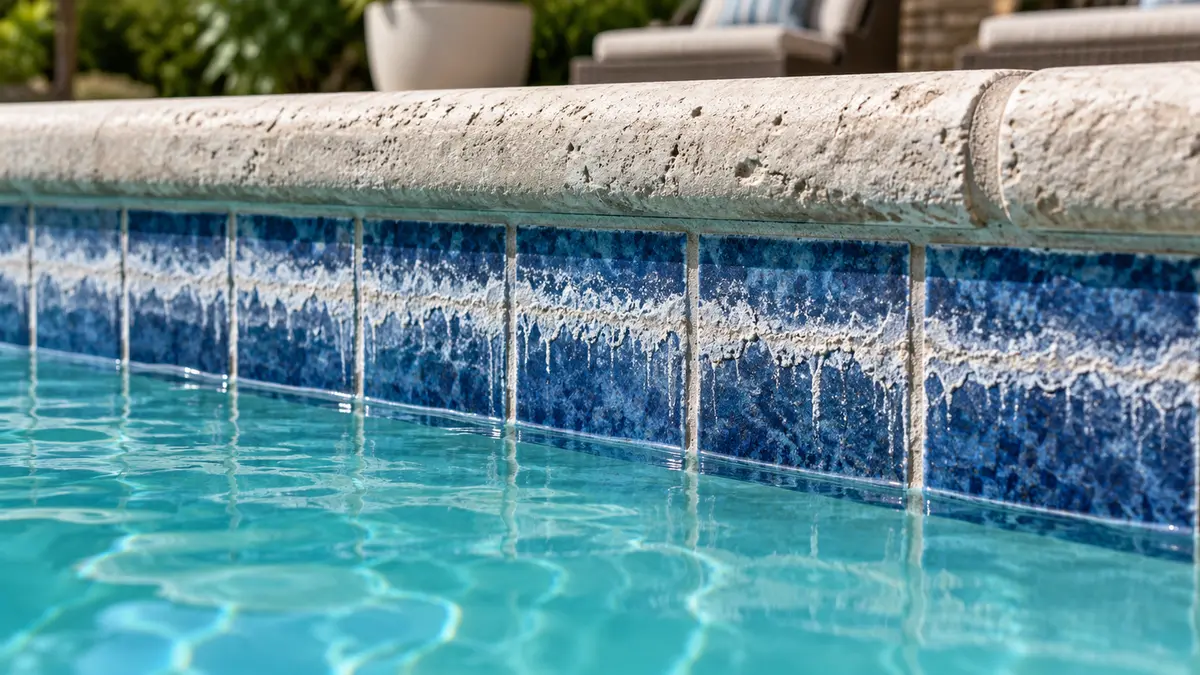
- Grayish-white crust at the waterline tile
- Cloudy water, especially after raising pH
- Scale inside the heater, which cuts its efficiency
- White flakes on the salt cell plates
Heat makes scaling worse. Water inside a heater or a hot spa is much more likely to drop calcium than water in the main pool, so pools with gas heaters or heat pumps benefit from keeping CH and pH out of the high end.
How to raise calcium hardness with calcium chloride
Calcium chloride comes in two common forms, and the calculator handles both:
| Type | Typical label | Dose for +10 ppm per 10,000 gal |
|---|---|---|
| Dihydrate flakes | 77–80% calcium chloride | About 1.2 lb |
| Anhydrous pellets | 94–97% calcium chloride | About 1.0 lb |
The formula is lb = 1.2 × (CH increase ÷ 10) × (gallons ÷ 10,000) for 77–80% flakes.
Worked example: a 15,000-gallon plaster pool reads 150 ppm and the target is 300 ppm. 1.2 × 15 × 1.5 = 27 lb of 77% flakes. The calculator gives about 22.2 lb of 94% anhydrous pellets for the same rise.
How to add it:
- Calcium chloride gets hot when it dissolves. If you pre-dissolve, fill a bucket with pool water first, add the calcium slowly, and stir with a plastic or wooden stick.
- Some manufacturers instead tell you to broadcast it across the surface with the pump running. Follow your product’s label.
- Add large doses in two or three portions so pH and cloudiness stay manageable.
- Brush any granules off the floor so they do not sit on plaster or vinyl.
- Retest after 24 hours of circulation.
Products sold as “calcium hardness increaser” are usually calcium chloride. The percentage on the label tells you which setting to choose.
How to lower calcium hardness: the dilution formula
The only practical way to lower calcium in a home pool is to replace some of the water with softer water. The share to replace is:
share to replace = (current − target) ÷ (current − fill water hardness)
Worked example: a 15,000-gallon pool reads 600 ppm, the target is 400 ppm, and the fill water is 150 ppm. (600 − 400) ÷ (600 − 150) = 0.44, so replace 44%, about 6,667 gallons.
Fill water hardness changes the answer sharply:
| Fill water hardness | Share to replace (600 → 400 ppm) |
|---|---|
| 0 ppm (soft or RO water) | 33% |
| 150 ppm | 44% |
| 300 ppm | 67% |
| 400 ppm or higher | Not possible by dilution |
When fill water is at or above your target, draining and refilling cannot get you there. The alternatives are a reverse-osmosis water service, a higher CH target with pH and alkalinity kept toward the low end, or accepting more frequent descaling.
Safe draining
Do not drain more than about a third of the pool at once without checking your pool builder’s guidance. High groundwater can push an empty or near-empty inground pool out of the ground, and vinyl liners can shrink or shift when left exposed. Doing the replacement in several partial cycles is slower but safer. Check local rules on where pool water can be discharged, and lower chlorine before draining if they require it.
Common calcium hardness mistakes
- Using total hardness from a strip as calcium hardness. It overstates calcium in water that contains magnesium.
- Ignoring fill water. Topping up with hard water raises CH all season as water evaporates and leaves calcium behind.
- Raising calcium while pH is high. That combination clouds the water and drops calcium as scale.
- Choosing the wrong purity setting. Entering 77% for anhydrous pellets overdoses by roughly a fifth.
Wear gloves and eye protection, keep calcium chloride dry and away from other chemicals, and never add water to the product. Balance calcium alongside your other readings with the pool chemical calculator, and see ideal pool water chemistry levels for every target range in one chart.