How to use the pool alkalinity calculator
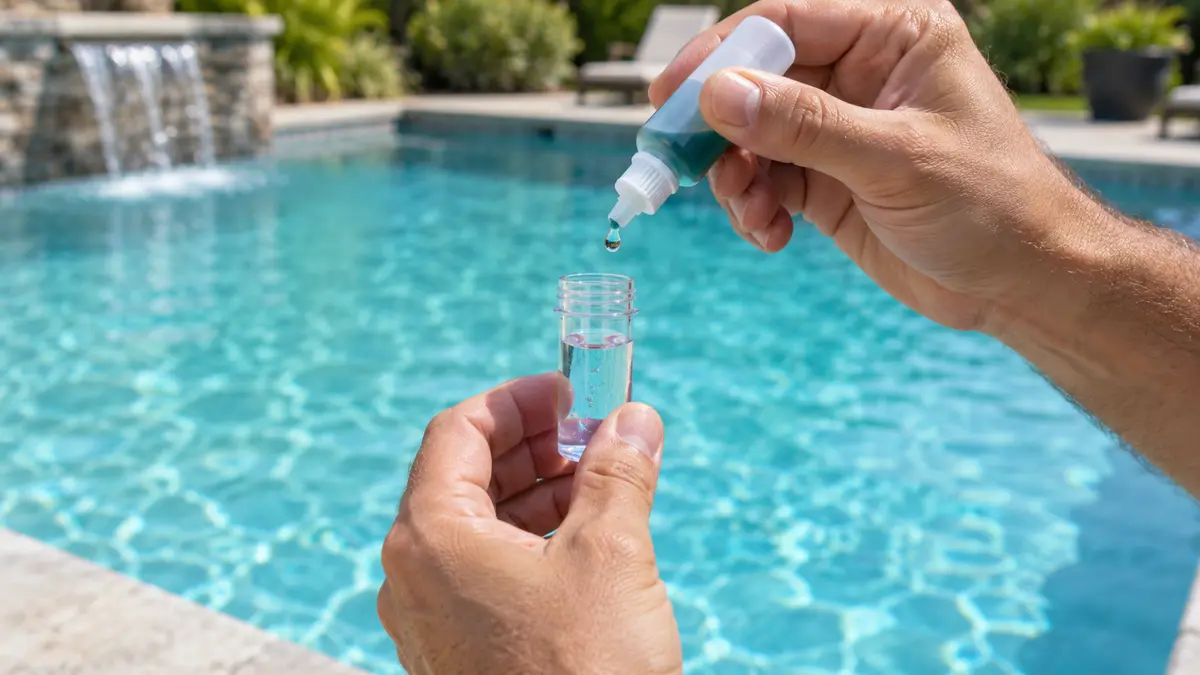
Enter your gallons, current total alkalinity (TA), target TA and the acid strength you buy. If the target is higher, the calculator gives pounds of baking soda. If it is lower, it gives the total muriatic acid needed to remove that much alkalinity, which you add in stages over several days. Use a recent drop-test result, since test strips are coarse for TA.
What does total alkalinity do in a pool?
Total alkalinity is the water’s capacity to resist pH change. Most of it is bicarbonate and carbonate, which absorb acid before pH can drop and give up CO2 as pH rises. Taylor Technologies describes TA as the buffering capacity of water and lists 80–120 ppm as ideal, with 60 ppm as a minimum.
The buffer has to be the right size:
- Too low (below about 60 ppm): pH swings with every rainstorm, chlorine addition or swim party. This is often called “pH bounce.”
- Too high (well above 120 ppm): pH keeps climbing, and every pH correction takes more acid.
- About right: pH holds within a tenth or two between tests, and acid use is modest.
TA vs pH: why people confuse them
pH is how acidic the water is right now. Total alkalinity is how much it resists changing. They move together under some products and apart under others, which is where the confusion comes from.
| Product or action | Effect on pH | Effect on TA |
|---|---|---|
| Baking soda | Slight rise | Strong rise |
| Soda ash | Strong rise | Moderate rise |
| Borax | Rise | Small rise |
| Muriatic or dry acid | Drops | Drops |
| Aeration (fountains, jets, spillovers) | Rises | No change |
| Trichlor tablets over time | Drops | Drops |
Two practical rules follow from that table. To raise TA without overshooting pH, use baking soda. To lower TA, you must use acid, and the only way to bring pH back up without putting TA back is aeration.
How to raise total alkalinity with baking soda
The calculator uses about 1.4 lb of baking soda per 10 ppm of TA per 10,000 gallons:
lb = 1.4 × (TA increase ÷ 10) × (gallons ÷ 10,000)
Worked example: a 20,000-gallon pool reads 60 ppm and you want 90 ppm. 1.4 × 3 × 2 = 8.4 lb of baking soda.
How to add it:
- Run the pump.
- Broadcast up to about 2 lb per 10,000 gallons at a time across the deep end, or pre-dissolve in a bucket of pool water.
- Brush any powder that settles on the floor.
- Wait a few hours, then retest before adding more.
Expect pH to rise slightly. If pH was already high, lower it with acid after the TA has mixed in.
How to lower total alkalinity: acid plus aeration
Lowering TA is a cycle, not a single dose. Acid removes alkalinity but also drops pH. Aeration then pushes pH back up by driving off CO2, without adding alkalinity back. Each lap of the cycle lowers TA a little more.
The calculator gives the total acid needed. It uses about 25.6 fl oz of 31.45% muriatic acid per 10 ppm of TA per 10,000 gallons.
Worked example: a 20,000-gallon pool reads 150 ppm and you want 100 ppm, a 50 ppm drop. 25.6 × 5 × 2 = 256 fl oz, which is 2 gallons of 31.45% acid in total. With half-strength 14.5% acid the calculator gives about 600 fl oz (4.69 gallons), because the weaker acid is also less dense.
The process:
- Test pH and TA.
- Add enough acid to bring pH to about 7.2. Size that dose with the pH dosing tool on this site, and never let pH fall below 7.0.
- Aerate: point return jets up at the surface, run waterfalls or fountains, or use a spray attachment on a hose. Aerate until pH is back near 7.6–7.8.
- Retest TA. Each cycle lowers it in proportion to the acid added: about 10 ppm per 25.6 fl oz per 10,000 gallons.
- Repeat until TA reaches your target. Spreading the total acid over several days is normal.
Swimming is fine between cycles once pH is back in range. Aeration is slow on still, cool days; heat, wind and running every water feature you have speed it up.
Adjusting your TA test for stabilizer
A standard TA test also counts cyanurate from your stabilizer, so the result reads higher than your true carbonate alkalinity. Taylor’s correction is to subtract one third of your CYA reading. With CYA 60 and a TA test of 100 ppm, carbonate alkalinity is about 80 ppm.
This matters most in salt pools and pools with high stabilizer, where the gap can be 20–30 ppm. The other calculators on this site, including the pH and saturation index tools, apply this correction automatically from the CYA you enter. Enter your raw TA test result here and set your target with the correction in mind.
Choosing a TA target for your pool
Pick a target inside 60–120 ppm based on how your pool behaves:
- Plaster pools: 80–120 ppm is common and helps protect the surface.
- Salt pools and heavily aerated pools: 60–80 ppm slows the constant pH rise.
- Trichlor-fed pools: the tablets steadily consume alkalinity, so staying toward the upper end gives you more cushion.
- Any pool where pH rises fast: lower TA by 10–20 ppm and watch whether acid use drops.
Common alkalinity mistakes
- Using baking soda to fix low pH. It barely moves pH; use soda ash unless TA is also low.
- Dumping all the acid at once to lower TA. It crashes pH, which can etch plaster and corrode equipment.
- Skipping aeration. Acid alone just lowers pH and TA together, then you end up adding base to fix pH and putting the TA back.
- Ignoring the CYA correction in salt or heavily stabilized pools.
Keep chemicals separate and wear gloves and eye protection whenever you handle acid. Always add acid to water, never water to acid. Check TA with your other readings in the pool chemical calculator, and find your gallons with the pool volume calculator if you have not measured them.