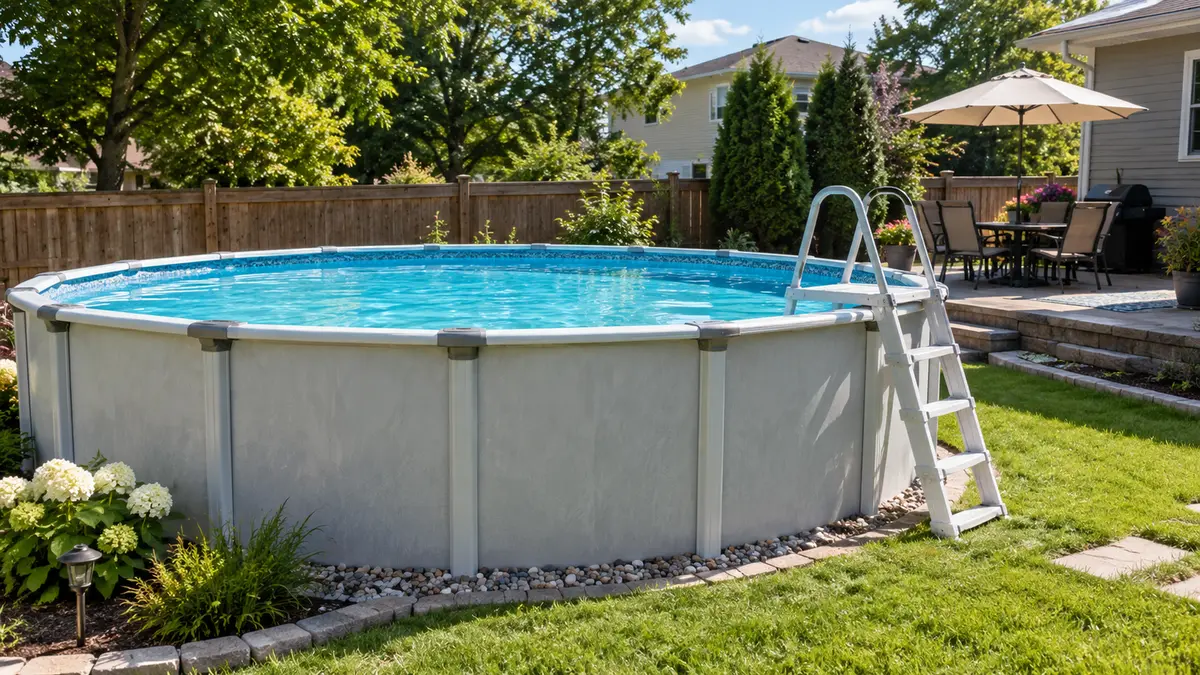
How to use the above ground pool gallons calculator
Choose a common size from the list, or pick round or oval and type in your own diameter or length and width. Then enter the water depth in inches. The calculator returns gallons and liters.
The one number to get right is water depth. Measure from the water surface straight down to the floor near the wall, or use the guideline of wall height minus about 6 inches if the pool is not filled yet. The tables above show standard round and oval sizes at 42, 48 and 52 inches of water.
Why use water depth instead of wall height?
Because the top few inches of the wall never hold water. The skimmer opening sits below the top rail, and the water is kept partway up that opening. A 54 in wall typically runs about 48 in of water, a 52 in wall about 46 in, and a 48 in wall about 42 in.
Getting this wrong inflates every dose:
| 24 ft round pool | Depth entered | Gallons |
|---|---|---|
| Correct: water depth | 48 in | about 13,536 |
| Mistake: wall height | 54 in | about 15,228 |
| Difference | 6 in | about 1,692 (12.5% high) |
Worked example: 18 ft round, 52 in wall
- Water depth: 52 − 6 = 46 in, or 46 ÷ 12 = 3.83 ft.
- Diameter squared: 18 × 18 = 324.
- Gallons: 324 × (46 ÷ 12) × 5.875 = about 7,297 gallons (about 27,622 liters).
How do liner type and a deep center change the volume?
The liner style decides where the water level sits and whether the floor is flat.
- Overlap liners drape over the wall and are held by coping strips. Fill level follows the skimmer, as above.
- Beaded and J-hook (uni-bead) liners hang from a track or the top of the wall. They usually allow the same fill level; the bead itself does not change volume.
- Expandable liners are made to sit in a floor that has been dug deeper in the middle. The extra depth adds real water, and the wall-height rule no longer tells the whole story.
Worked example: 21 ft round with an expandable liner
The water is 48 in (4 ft) deep at the wall and 6 ft deep at the center, with the floor sloping evenly between them.
- Average depth for an even slope to a center point: 4 + (6 − 4) ÷ 3 = 4⅔ ft.
- Gallons: 21 × 21 × 4⅔ × 5.875 = about 12,091 gallons.
A flat 21 ft pool at 48 in holds about 10,364 gallons, so the dug-out center adds roughly 1,700 gallons. If your deep area is a smaller bowl in the middle with a flat outer ring, take depth readings every couple of feet from wall to center and average them.
Oval above-ground pools
Oval above-ground pools are entered as length × width plus water depth. A 15 × 30 ft oval at 48 in holds about 10,575 gallons by ellipse math, and a 12 × 24 ft at 48 in holds about 6,768.
Many oval above-ground pools have long straight sides, held in place by side supports, rather than a continuous curve. Those hold more water than ellipse math suggests. If yours has straight sides, calculate it as a rectangle (width × straight length) plus a circle (width × width × 0.785), then multiply by depth × 7.48. A straight-sided 15 × 30 at 48 in works out to about 12,020 gallons.
Frame and inflatable pools
Smaller soft-sided pools use the same math. A 12 ft round frame pool with 30 in of water holds about 2,115 gallons.
Inflatable-ring pools have sloping sides: the top ring is wider than the floor. Average the two diameters before you calculate. A pool that measures 12 ft across the top ring and 10.5 ft across the floor averages 11.25 ft: at 30 in of water that is about 1,859 gallons. Using the 12 ft top measurement alone would read about 14% high.
How much does the water in an above-ground pool weigh?
A lot, which is why level, compacted ground matters. The USGS conversion factors put water at 8.34 pounds per gallon and 62.4 pounds per cubic foot.
- A 24 ft round pool with 48 in of water holds about 13,536 gallons, which weighs about 112,890 pounds, or roughly 56 tons.
- Every square foot of floor under 4 ft of water carries about 250 pounds (4 × 62.4).
A low spot under the pool lets that weight push the liner and wall out of shape, which also throws off your measurements. If one side of the water looks deeper than the other, measure depth on both sides and use the average.
Gallons per inch: partial drains and top-offs
For water changes, rain overflow and evaporation, gallons per inch is more useful than the total. Divide your pool’s gallons at a given depth by that depth in inches:
- 18 ft round: about 159 gallons per inch
- 24 ft round: about 282 gallons per inch
- 15 × 30 ft oval: about 220 gallons per inch
Lowering a 24 ft round by 6 inches removes about 1,692 gallons. Knowing that helps when you need to dilute high stabilizer or salt.
Above-ground pools sold in meters
Some above-ground pools are sold with metric sizes. Measure in meters and switch the calculator’s units, or work it by hand: liters = 0.785 × diameter² × water depth × 1,000.
A 5.5 m round pool with 1.2 m of water holds 0.785 × 5.5 × 5.5 × 1.2 = about 28.51 m³, or about 28,510 liters (about 7,532 US gallons). Apply the same rule as in feet: use the water depth, not the wall height printed on the box.
When should I recalculate?
Recalculate after anything that changes the shape or the fill level: a new liner (especially switching to an expandable liner), re-leveling the pool, or deciding to run the water higher or lower than before. A few inches of depth on a 24 ft pool is several hundred gallons, enough to shift salt and stabilizer doses noticeably.
Common mistakes with above-ground pools
- Entering wall height as depth. The most common error, typically 10 to 15% high.
- Measuring over the top rails or uprights. Measure the inside diameter of the wall.
- Ignoring a dug-out center. Expandable liners add real volume.
- Using the ellipse formula on a straight-sided oval. It reads low.
- Measuring depth on a pool that is not level. Average a reading from each side.
For inground pools, irregular shapes or a metric-only workflow, the full pool volume calculator handles every shape.