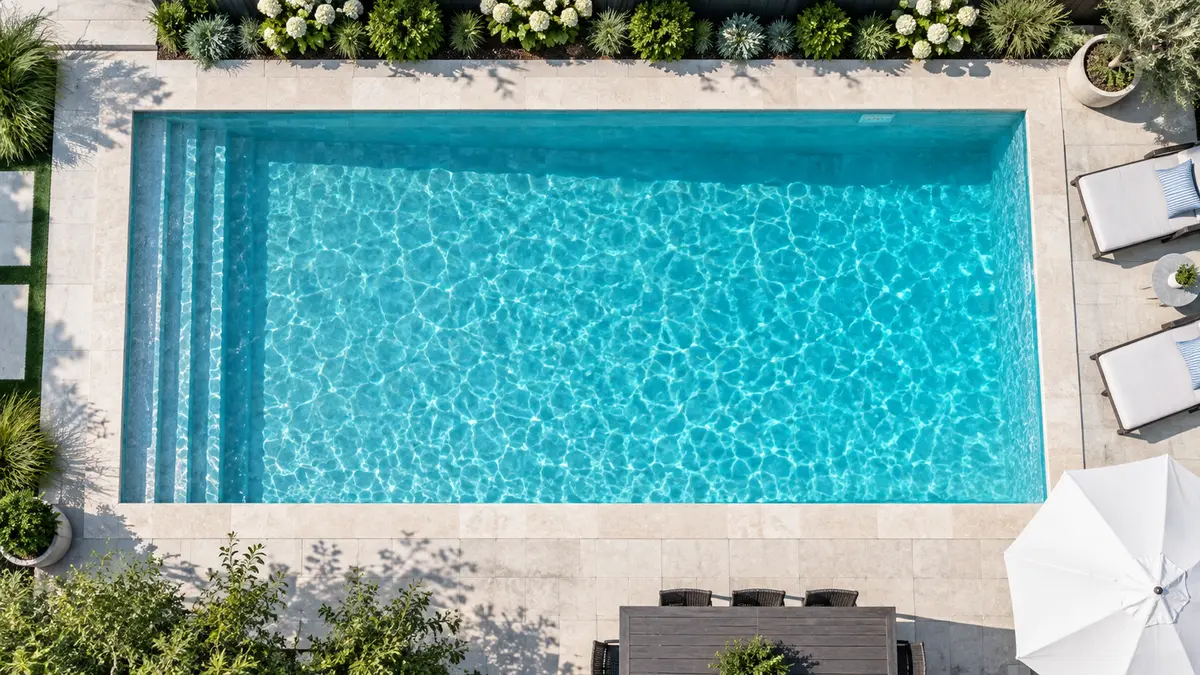
How to use the rectangle pool volume calculator
Enter the inside length and width, then the water depth at the shallow end and the deep end. The calculator averages the two depths and returns gallons and liters. If the floor is flat, enter the same depth twice. Switch units to meters if your tape or plans are metric.
That is all you need for a rectangle with an even slope. The sections below cover the cases where the simple inputs need a little help: diving hoppers, L-shapes and long lap pools.
What is the formula for a rectangular pool’s volume?
Gallons = length × width × average depth × 7.48. Length, width and depth are in feet, average depth is (shallow + deep) ÷ 2, and 7.48 converts cubic feet to US gallons. The USGS water conversion factors list exactly that: one cubic foot holds 7.48 gallons.
You will sometimes see 7.5 used as a rounded shortcut in pool-operator training material. It runs about 0.3% high, which is harmless for dosing.
Worked example: 18 × 36 ft pool, 3.5 to 8 ft deep
- Surface area: 18 × 36 = 648 sq ft.
- Average depth: (3.5 + 8) ÷ 2 = 5.75 ft.
- Cubic feet: 648 × 5.75 = 3,726 cu ft.
- Gallons: 3,726 × 7.48 = about 27,872 gallons.
- Liters: 27,872 × 3.785 = about 105,509 liters.
A smaller 12 × 24 ft pool going from 3.5 to 5 ft deep averages 4.25 ft: 288 sq ft × 4.25 × 7.48 = about 9,156 gallons.
How do I measure a rectangular pool?
Measure inside the pool walls at the waterline, then measure water depth at each end. Skip the coping, the deck and any tile band above the water, because those make the pool look bigger than the water it holds.
A few habits make the numbers reliable:
- Measure length and width twice, near each end. If the two lengths differ by more than a few inches, average them.
- Keep the tape level and taut. A sagging tape over 30 or 40 feet adds inches.
- Measure depth at the deepest and shallowest points of the floor, from the water surface down. A telescoping pole with a tape attached, or a tape with a small weight on the end, works well.
- Ignore rounded corners. A rectangle with 2 ft radius corners loses only about 3.4 sq ft of area, roughly 141 gallons in a 5.5 ft deep pool. That is well under 1% of a typical rectangle.
What about hopper and sport bottoms?
Diving pools with a hopper bottom do not slope evenly, so (shallow + deep) ÷ 2 overstates the volume. The maximum depth exists only in a small bowl, and the hopper’s sides slope up toward the walls.
The fix is the zone method: split the pool where the floor changes, average the depth inside each zone, and add the zones together.
Worked example: 18 × 36 ft pool with a hopper
Suppose the 18 × 36 pool above has a flat-ish shallow area 14 ft long that goes from 3.5 to 4 ft, then a 22 ft deep zone with a hopper.
- Shallow zone: 18 × 14 ft at an average of (3.5 + 4) ÷ 2 = 3.75 ft. Volume: 18 × 14 × 3.75 × 7.48 = about 7,069 gallons.
- Deep zone: take five evenly spaced depth readings down the center of the deep end, for example 4, 6, 8, 7 and 5 ft. Their average is 30 ÷ 5 = 6 ft. Volume: 18 × 22 × 6 × 7.48 = about 17,774 gallons.
- Total: 7,069 + 17,774 = about 24,843 gallons.
The simple two-depth method gave 27,872 gallons for the same pool, about 12% more. If you care about precision, also take a few readings closer to the side walls in the deep zone, where the hopper slopes up.
A sport pool, which is shallow at both ends and deepest in the middle, works the same way. Take depth readings every few feet along the length and average all of them.
How do I calculate an L-shaped or T-shaped pool?
Split the outline into rectangles that do not overlap, calculate each one with its own average depth, and add them. Never use the outer bounding rectangle, because it counts a corner of deck as water.
Worked example: L-shaped pool
The main body is 16 × 32 ft averaging 5 ft deep, and a shallow 8 × 12 ft extension off one side sits at a flat 3.5 ft.
- Main body: 16 × 32 × 5 × 7.48 = about 19,150 gallons.
- Extension: 8 × 12 × 3.5 × 7.48 = about 2,513 gallons.
- Total: about 21,664 gallons.
Treating the whole thing as one 24 × 32 ft rectangle at 5 ft would give about 28,725 gallons, roughly a third too high. A T-shape is the same idea with three rectangles instead of two.
Lap pools, plunge pools and sun shelves
Long, narrow lap pools are usually a near-constant depth, which makes them easy. A 10 × 50 ft lap pool at a flat 4 ft holds 10 × 50 × 4 × 7.48, about 14,961 gallons. An 8 × 40 ft lap pool at 4.5 ft holds about 10,772 gallons.
Plunge pools are small and often deep, so depth dominates. Measure it carefully rather than trusting the plan drawing.
A sun shelf or tanning ledge is a wide, shallow step, often less than a foot of water. Calculate it as its own rectangle with its own depth. It adds surface area quickly but very little volume.
Rectangle pool sizes and depth: what changes the total most?
Depth changes the total faster than most owners expect. On a 16 × 32 ft pool, every extra foot of average depth adds 512 cubic feet, or about 3,830 gallons. Adding a foot of length adds only 16 × 5.5 = 88 cubic feet at a 5.5 ft average, about 658 gallons.
That is why two pools with the same footprint can differ by thousands of gallons, and why the depth columns in the table above spread so far apart. When in doubt, spend your measuring effort on depth.
Common mistakes with rectangular pools
- Measuring outside the coping. A 16 × 32 pool measured as 17 × 33 ft reads about 10% high.
- Using wall height for depth. Water usually sits partway up the skimmer opening, several inches below the coping.
- Using the two-depth average on a hopper. Use the zone method above instead.
- Using a bounding rectangle for L-shapes. Split it into pieces.
- Forgetting a spillover spa. If the spa shares water with the pool, calculate it separately and add it.
Once your rectangle is measured, the main pool volume calculator covers every other shape if your pool has round or curved sections to add on.