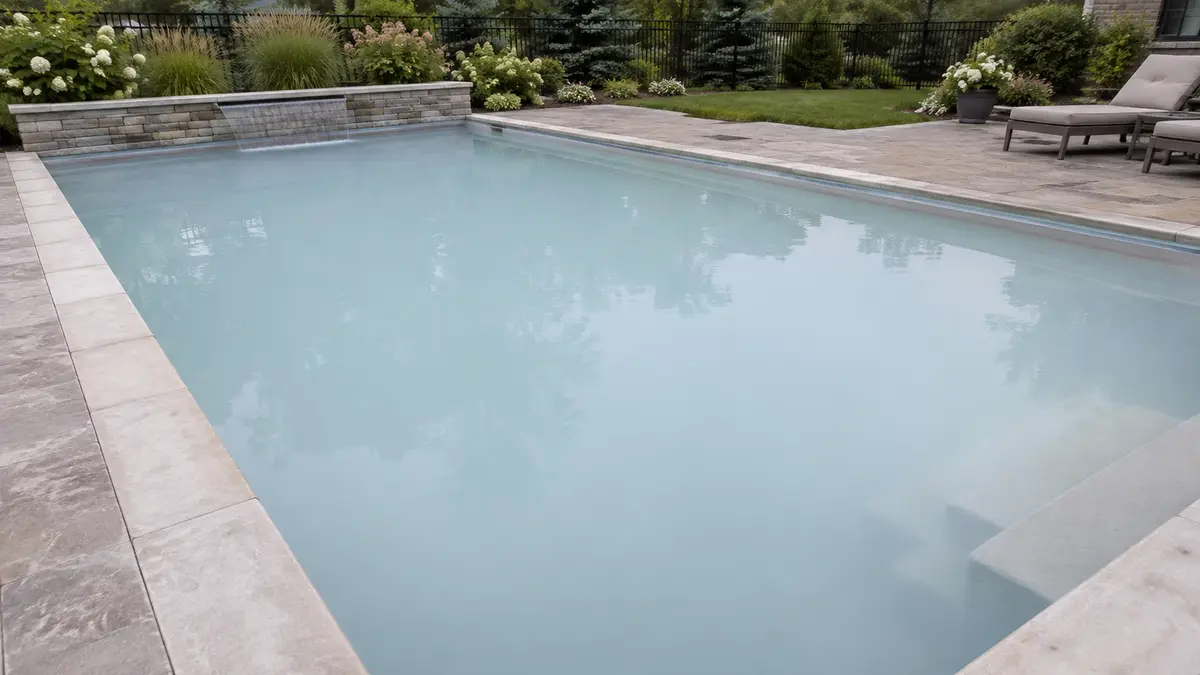
Why is my pool water cloudy?
Cloudy pool water means fine particles are suspended in the water and the filter is not removing them as fast as they form. The most common cause is free chlorine running too low for the pool’s cyanuric acid level, which lets algae start before it turns visibly green. Scaling chemistry, filter problems and fine debris account for most other cases.
| Cause | Typical signs | How to confirm | Fix |
|---|---|---|---|
| Low chlorine for CYA | Dull, hazy water; chlorine keeps dropping | FC below about 7.5% of CYA; CC above 0.5 ppm | Shock to 40% of CYA and hold |
| Early algae | Haze plus slippery walls, worst in shady spots | Overnight chlorine loss above 1 ppm | Shock and hold until all tests pass |
| High pH or calcium (scaling) | Milky white haze; rough scale at the waterline | pH above 7.8; saturation index above +0.3 | Lower pH; dilute if CH is very high |
| Filtration problems | Cloudy despite good chemistry; low flow | High or unchanging filter pressure; short run times | Clean or repair filter; run pump longer |
| Fine particles | Haze after storms, pollen, construction or new plaster | Chemistry tests normal | Filter continuously; clarifier or floc optional |
Many cloudy pools have more than one cause, such as low chlorine plus a dirty filter. Fix chemistry first, then filtration.
How to clear cloudy pool water
Start with an accurate test, decide whether algae is involved, and then fix balance and filtration. Guessing and adding several products at once usually makes cloudy water last longer.
- Test with a drop kit. Measure free chlorine, combined chlorine, pH, total alkalinity, calcium hardness and CYA. Compare them with the ideal pool water chemistry levels.
- Rule algae in or out. If FC has been below the minimum for your CYA, CC is above 0.5 ppm, or chlorine drops more than 1 ppm overnight, treat it as algae.
- If algae is likely, shock and hold. Raise FC to 40% of CYA (16 ppm at 40 ppm CYA) and keep it there, testing several times a day, until CC is 0.5 ppm or less, the water is clear, and overnight loss is 1 ppm or less.
- Bring pH into range. Aim for 7.2–7.8. High pH makes chlorine weaker and encourages calcium to come out of solution.
- Clean the filter. Backwash a sand or DE filter, or hose off cartridges. Check for torn cartridges, channeled sand or broken DE grids.
- Run the pump continuously. Filter 24 hours a day until the water is clear, brushing daily to lift settled particles back into circulation.
Trouble Free Pool’s cloudy water guide follows the same order: accurate testing first, algae second, then filtration and circulation. Fixing the cause matters more than any product.
Worked example: chlorine too low for the CYA
A 15,000-gallon (56,800 L) pool reads 2 ppm free chlorine and 50 ppm CYA, with a light haze. The minimum for 50 ppm CYA is 3.75 ppm, so the chlorine is below the floor where algae is controlled. Shock level is 50 × 0.40 = 20 ppm, an 18 ppm rise.
Liquid chlorine at 10% needs 12.8 fl oz per 1 ppm per 10,000 gallons, so the dose is 18 × 12.8 × 1.5 = about 346 fl oz, or roughly 2.7 gallons (10.2 L). Use the pool chemical calculator for exact amounts with your product and volume.
Clarifier vs flocculant: which should you use?
Use neither until chemistry and filtration are right. Clarifier helps a working filter catch very fine particles; flocculant drops particles to the floor so you can vacuum them out to waste. Both treat the symptom, not the cause, and overdosing either can make the water cloudier.
| Clarifier | Flocculant (floc) | |
|---|---|---|
| How it works | Joins tiny particles into clusters the filter can trap | Clumps particles so they sink to the floor |
| Pump | Keep running | Off overnight while particles settle |
| Cleanup | Filter does the work; clean it more often | Vacuum the settled layer to waste, bypassing the filter |
| Water loss | None | Some, from vacuuming to waste |
| Best for | Slight haze with a working filter | Heavy fine debris when you can vacuum to waste |
| Risk | Overdose makes water cloudier and can gum up filters | Wasted effort if not vacuumed carefully; does not kill algae |
Follow the label dose exactly and wait for the result before adding more. Cartridge filters usually cannot vacuum to waste, so floc is a poor fit for them.
How long does cloudy water take to clear?
Most cloudy pools clear in one to several days once the cause is fixed and the pump runs continuously. Heavy algae, a sand filter, or very fine particles such as plaster dust can stretch that to a week or more.
Filter type matters. Sand filters trap the coarsest particles, cartridges are finer, and DE filters catch the finest. A sand filter may need many turnovers to polish water that a DE filter clears in a day or two. Turnover time is gallons ÷ pump GPM ÷ 60: a 15,000-gallon pool at 40 GPM turns over about every 6.3 hours, so roughly four times a day with the pump running continuously.
Signs you are making progress: filter pressure slowly climbing as it catches particles, and the main drain becoming visible from the deep end. If nothing changes after two or three days of good chemistry and continuous filtering, inspect the filter itself.
How to prevent cloudy water
Keep free chlorine at or above the minimum for your CYA every day, keep pH and calcium from pushing the water toward scale, and keep the filter clean. Those three habits prevent nearly all cloudy water.
- Test free chlorine and pH every day or two in swimming season.
- Keep CYA at 30–50 ppm (60–80 ppm in salt pools) so chlorine targets stay practical.
- Run the pump long enough to turn the water over at least once a day.
- Clean the filter when pressure rises about 25% above its clean reading.
- Add chlorine after storms, pollen bursts and heavy use.
Chemical safety
Add one chemical at a time with the pump running, and let it circulate before adding the next. Always add chemicals to water, never water to chemicals. Keep acid and chlorine apart, never mix products, and wear gloves and eye protection.
For weekly routine, seasonal care and draining guidance, see the pool water care guide.