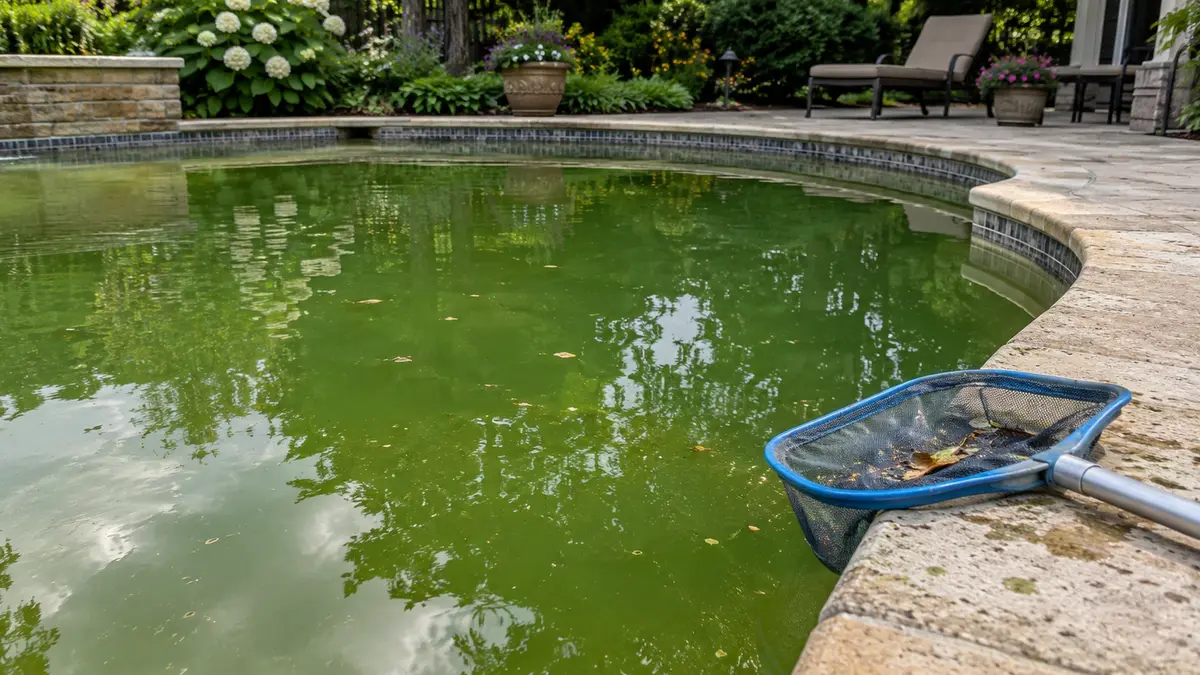
Why is my pool water green?
Pool water turns green when free chlorine falls too low for the pool’s cyanuric acid level long enough for algae to grow. The usual triggers are a missed day or two of chlorine, a heat wave, heavy rain, a pump or salt cell failure, or stabilizer that has built up so high that normal chlorine levels no longer work.
Common causes, roughly in order of how often they happen:
- Chlorine below the minimum for your CYA. The minimum is about 7.5% of CYA, so 3 ppm at 40 ppm CYA and 5.25 ppm at 70 ppm.
- CYA too high. Trichlor tablets add stabilizer with every dose, and high CYA quietly raises the chlorine you need.
- Poor circulation or filtration. Short pump run times, a dirty filter, or dead spots behind steps and in corners.
- Weather and use. Heat, sunlight, rain and heavy swimmer load all burn chlorine faster.
- Metals, not algae. Clear green water after adding chlorine can be copper or iron. Test for metals if the water is green but not cloudy.
How to fix green pool water, step by step
The proven fix is to shock to about 40% of your CYA and hold that level until the water is clear and chlorine stops disappearing. Trouble Free Pool calls this SLAM (Shock Level and Maintain), and it works on every common type of algae without extra products.
- Test. Measure free chlorine, combined chlorine, pH and CYA with a FAS-DPD drop kit. Strips and plain color tests cannot read the high chlorine you are about to add.
- Know your gallons. Every dose depends on volume. If you are not sure, use the pool volume calculator.
- Adjust pH. Bring pH into the 7.2–7.6 range before shocking; chlorine works better at the lower end.
- Remove debris and brush. Net out leaves, then brush every surface, including steps, behind ladders, and inside skimmer throats.
- Raise chlorine to shock level. Target about 40% of CYA: 12 ppm at 30 ppm CYA, 16 ppm at 40, 20 ppm at 50. Liquid chlorine is the cleanest choice because it adds no stabilizer or calcium.
- Hold it there. Test at least three times a day and add chlorine each time to get back to shock level. Brush daily.
- Filter around the clock. Run the pump 24 hours a day and clean or backwash when filter pressure climbs about 25% above its clean reading.
- Check the finish line. Stop when combined chlorine is 0.5 ppm or less, the water is crystal clear, and an overnight chlorine loss test shows 1 ppm or less of loss.
Worked example: shocking a 20,000-gallon pool
A 20,000-gallon (75,700 L) pool reads 0 ppm free chlorine and 40 ppm CYA. Shock level is 40 × 0.40 = 16 ppm. Liquid chlorine at 10% needs 12.8 fl oz per 1 ppm per 10,000 gallons, so the dose is 16 × 12.8 × 2 = about 410 fl oz, or roughly 3.2 gallons (12.1 L). At 12.5% strength, the same rise takes about 328 fl oz, or 2.6 gallons.
Expect that level to fall quickly at first as the algae uses it up. Add chlorine again each time you test. Use the pool chemical calculator to get exact doses for your product and strength.
What if CYA is very high or zero?
If CYA is very high, shock level becomes impractical: at 100 ppm CYA you would need 40 ppm chlorine. Replace water first. Going from 100 to 50 ppm means replacing half the pool. If CYA is zero in an outdoor pool, sunlight destroys chlorine within hours, so bring CYA up to about 30 ppm before or during the shock.
Floc vs vacuum to waste
Flocculant clumps dead algae and fine particles so they sink to the floor in a layer you can vacuum out. Vacuuming to waste sends that layer out of the pool instead of through the filter. Both are optional; a filter running 24 hours a day will eventually clear the water on its own.
| Approach | How it works | Pros | Cons |
|---|---|---|---|
| Filter only | Filter catches dead algae over days | No extra product, no water loss | Slower; frequent filter cleaning |
| Floc + vacuum to waste | Particles settle overnight; vacuum them out past the filter | Fast clearing of heavy debris | Pump must be off overnight; loses water; needs a waste or drain setting |
| Clarifier | Joins fine particles so the filter can trap them | Helps a weak filter | Overdosing can make cloudiness worse |
Floc only works if you can vacuum to waste, which requires a multiport valve with a waste setting or a separate drain hose. Cartridge filters usually cannot vacuum to waste through the filter. Do not floc while shocking unless you can keep chlorine at shock level, because algae left behind will regrow.
When should you drain a green pool?
Most green pools do not need draining; shocking and holding works even on water so dark you cannot see the floor. Drain partially when CYA or calcium is too high to correct any other way, or when the pool holds so much rotting debris that chlorine demand cannot be met.
If you do drain, do it in stages and do not empty an inground pool without checking your builder’s guidance. Groundwater can push an empty shell upward, and vinyl liners can shrink or tear once exposed.
Green, mustard and black algae compared
All three are killed by holding shock level, but mustard and black algae take longer and need more brushing.
| Type | What it looks like | Where it grows | Extra steps |
|---|---|---|---|
| Green | Green tint, slimy walls, cloudy green water | Anywhere, worst in shady spots | Standard shock-and-hold |
| Mustard (yellow) | Yellow-brown dusty patches that brush away and return | Shady walls, steps, floor | Wash swimsuits, toys, brushes and cleaner in chlorinated water to stop reinfection |
| Black | Dark blue-black spots with raised heads, firmly rooted | Plaster and gunite surfaces | Scrub spots daily with a stainless brush on plaster (not vinyl); expect a longer hold |
How to keep the water from turning green again
Prevention is cheaper than recovery: keep chlorine at or above the minimum for your CYA every single day. The target is about 11.5% of CYA, and testing every day or two in season catches drops before algae does.
- Keep CYA at 30–50 ppm, or 60–80 ppm in a salt pool. Check the full ideal pool water chemistry levels chart once a month.
- Run the pump long enough to turn the water over at least once a day.
- Brush weekly, especially low-circulation spots.
- Add chlorine after storms, parties and heat waves, not the next morning.
- Clean the filter when pressure rises.
Safety while shocking
Wear gloves and eye protection, pour chlorine into the water near a return with the pump running, and never add water to chemicals. Keep chlorine and acid apart, never mix products, and never put calcium hypochlorite in a skimmer or feeder that has held trichlor tablets; the two can react violently. Keep swimmers out until chlorine falls back into a normal range.
For routine care, seasonal changes and filling the pool, see the pool water care guide.