How much does a concrete pool cost?
A concrete pool costs about $50,000 to $120,000 installed by HomeGuide’s figures, or $165 to $300 per square foot. Other guides land inside that range: Fixr reports $50,000 to $90,000 with a $60,000 national average, and This Old House lists a 12 × 24 ft concrete pool at $58,000 to $100,000.
| Source | Range | Per sq ft | What the figure describes |
|---|---|---|---|
| HomeGuide | $50,000–$120,000 | $165–$300 | Gunite pool, installed, by size and depth |
| Fixr | $50,000–$90,000 (avg $60,000) | $100.50–$312.50 custom concrete; $111–$278 shotcrete | Average is a 12 × 24 ft shotcrete pool with tile and basic equipment |
| This Old House | $58,000–$100,000 | $200–$350 | 12 × 24 ft concrete pool, installation |
The low end buys a modest rectangle with standard plaster, basic equipment and a simple deck. The high end buys a larger or deeper pool, custom shape, tile or pebble finish, heater, automation and features such as spillover spas or tanning ledges. To price concrete against fiberglass and vinyl with your own add-ons, use the inground pool cost calculator.
What is the difference between gunite and shotcrete?
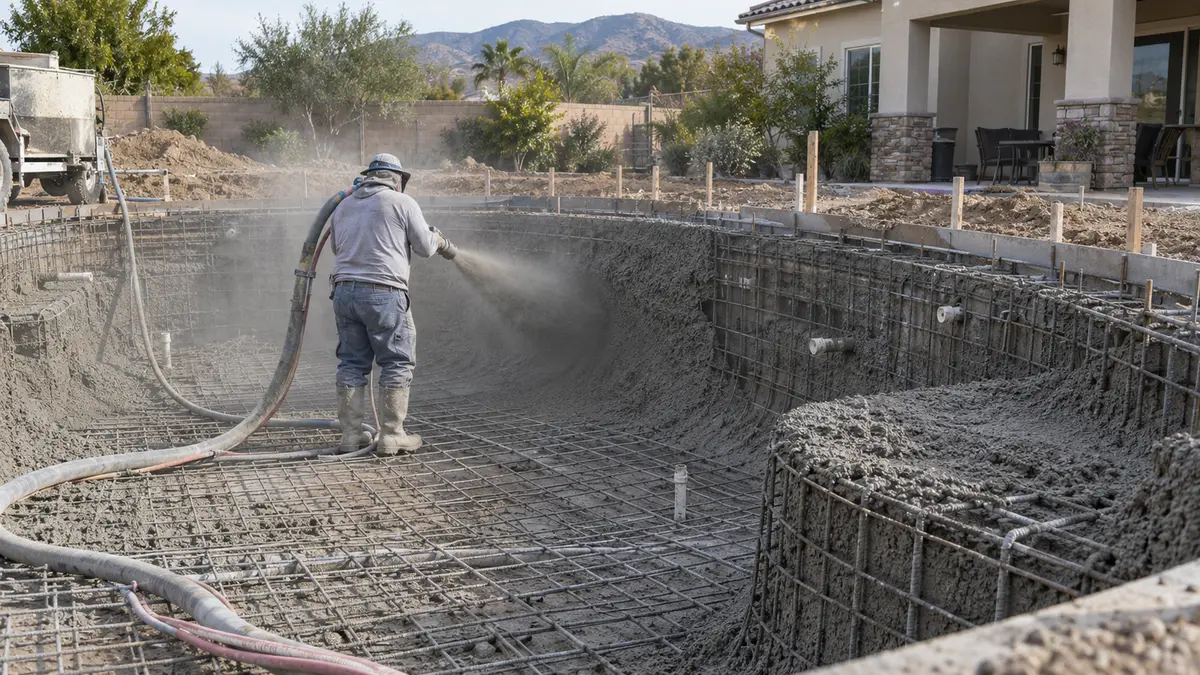
Gunite and shotcrete are both sprayed concrete applied over a steel rebar cage; the difference is when the water is added. Gunite is a dry mix that meets water at the spray nozzle, while shotcrete arrives already mixed from a concrete truck. Both produce a durable custom shell.
Fixr’s per-square-foot ranges for the two overlap almost completely ($100.50–$312.50 for custom concrete, $111–$278 for shotcrete). In practice, the method a builder uses matters far less to the price than the pool’s size, the finish you choose and the conditions on your site. Pick the builder for their track record, not the spray method.
What goes into a concrete pool price?
A concrete pool is built on site in stages, and each stage is a cost line you should see in a quote.
- Design and permits. Plans, engineering where required, and permit fees.
- Excavation. Digging, shaping the hole and hauling away soil. Rock or groundwater add cost.
- Steel. A rebar grid that gives the shell its shape and strength.
- Plumbing. Main drains, returns, skimmer lines and runs to the equipment pad.
- Shell. Gunite or shotcrete sprayed and shaped, then left to cure.
- Tile and coping. Waterline tile and the cap around the pool edge.
- Equipment. Pump, filter, sanitizer and any heater or automation, plus electrical work.
- Interior finish. Plaster, quartz or pebble applied over the cured shell.
- Deck and start-up. Decking around the pool, the first fill and start-up chemistry.
Quotes differ most on stages 2, 7 and 9. One builder may include a basic deck and heater while another prices the shell and plaster only, so a lower number is not always a cheaper pool. Ask each builder to price the same equipment list and deck area, and to state the allowance for rock or groundwater, before you compare totals.
Which interior finish should I choose?
Standard plaster is the cheapest finish but wears out fastest; quartz and pebble cost more and last longer. Because every concrete pool is eventually resurfaced, finish choice affects both the build price and how often you pay to redo it.
| Finish | How long it lasts (HomeGuide) | Resurfacing cost (HomeGuide) |
|---|---|---|
| Standard plaster | 7–12 years | $6,000–$8,000 |
| Quartz plaster | 10–15 years | $7,000–$10,000 |
| Pebble | 15–20+ years | $7,000–$15,000 |
| Full tile | Not stated | $8,000–$30,000+ |
HomeAdvisor is less optimistic about plaster, saying a solid plaster job should hold up for 5 to 10 years. It puts resurfacing at $6,000 to $15,000, with most homeowners paying about $11,000, or about $6,500 per 1,000 sq ft to refinish a gunite pool. Refilling the pool afterward costs another $40 to $2,000, according to HomeGuide.
How long does a concrete pool take to build?
HomeGuide says a concrete pool takes 6 to 8 weeks to build, while HomeAdvisor says full installation takes 3 to 6 months. The two figures measure different things: the shorter one is construction, the longer one includes everything from design and permitting through curing and finish work.
Curing time is the part you cannot rush. The shell has to cure before plaster goes on, and weather can pause excavation and spraying. If you want to swim by a certain date, plan around the longer figure and sign the contract well ahead of your season.
What does a concrete pool cost to own?
Concrete has the highest running costs of the three inground types. HomeGuide estimates chemicals at about $750 a year for a concrete pool, and This Old House puts 10-year maintenance at $27,000 to $40,000, compared with $11,000 to $17,000 for vinyl.
Worked example, 20 years. With standard plaster lasting 7 to 12 years, a concrete pool needs one or two replasters in 20 years. At HomeGuide’s $6,000–$8,000 replaster price, that is $6,000 to $16,000. Add HomeGuide’s $750 a year in chemicals and the 20-year total for those two items alone is $21,000 to $31,000, before electricity, service and equipment replacement.
Balanced water protects that plaster. Water that is aggressive, meaning low in pH, alkalinity or calcium, dissolves calcium from the surface and shortens its life. Taylor Technologies’ guide to the Langelier Saturation Index explains that an index below −0.3 can corrode concrete or metal surfaces, while above +0.5 can cause cloudiness and scaling. Testing regularly and keeping the index near zero is the cheapest way to stretch the time between resurfacing jobs.
Is a concrete pool worth the cost?
A concrete pool is worth it when you want a shape, size, depth or feature set no fiberglass mold offers, or when you plan to stay in the home long enough to value a shell that can last 50 years or more. It is the wrong choice if the lowest lifetime cost is your top priority.
Choose concrete if:
- You want a custom shape, a deep diving end or integrated features such as a spa or beach entry.
- Your site needs a pool fitted to an unusual lot.
- You are comfortable budgeting for resurfacing every decade or so.
Look at other types if:
- You need the pool within a few weeks of signing.
- You want the lowest chemical and maintenance spend.
- Your upfront budget is near the bottom of the published ranges.
To estimate how many gallons your planned pool holds, which drives fill cost and chemical doses, use the pool volume calculator.