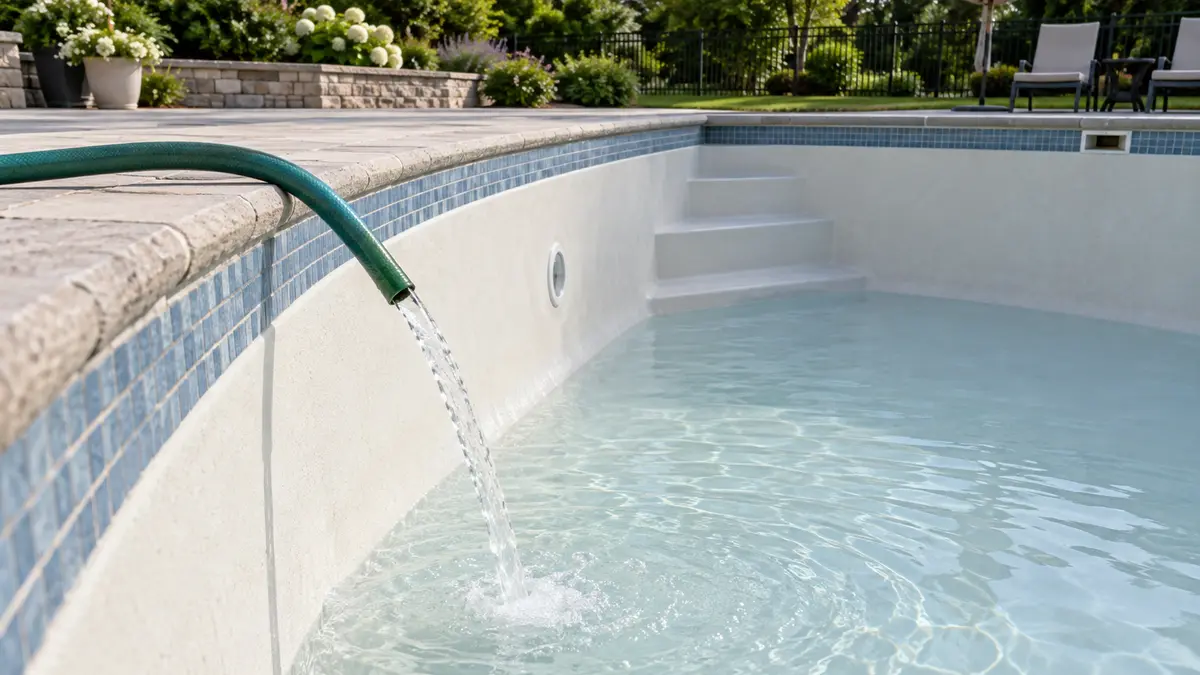
Using the how long to fill a pool calculator
Enter your pool’s volume in gallons, your hose’s flow rate in GPM and the number of hoses. If you time a 5-gallon bucket, type the seconds into the optional box and the calculator uses your measured flow instead of the GPM figure. The result is total fill time in hours.
If you do not know your gallons yet, get them first from the pool volume calculator. Fill time is only as good as the volume you feed it.
What is the formula for pool fill time?
Hours = gallons ÷ GPM ÷ 60. Dividing gallons by gallons per minute gives minutes, and dividing by 60 turns minutes into hours.
Worked example: 16 × 32 ft pool, one hose
The pool holds about 21,065 gallons, and the hose delivers 10 GPM.
- Minutes: 21,065 ÷ 10 = 2,106.5 minutes.
- Hours: 2,106.5 ÷ 60 = about 35.1 hours.
That is a day and a half of continuous filling. At 17 GPM the same pool fills in about 20.7 hours; at 9 GPM it takes about 39 hours.
Worked example: 24 ft round pool, two hoses
A 24 ft round above-ground pool with 48 in of water holds about 13,536 gallons. One hose at 10 GPM takes about 22.6 hours. Two hoses on separate spigots, each delivering 10 GPM, give 20 GPM in total and cut the fill to about 11.3 hours, but only if both really flow 10 GPM at the same time.
How do I measure my hose’s flow rate?
Time how long it takes to fill a 5-gallon bucket, then divide 300 by the seconds. The answer is gallons per minute. This bucket test beats any typical figure because it captures your actual water pressure, hose and spigot.
| Seconds to fill 5 gallons | Flow rate |
|---|---|
| 18 seconds | about 16.7 GPM |
| 20 seconds | 15 GPM |
| 30 seconds | 10 GPM |
| 35 seconds | about 8.6 GPM |
To get a trustworthy number:
- Use the exact hose and spigot you will fill with, full length, fully open.
- Start the timer when the water hits the bucket and stop it at the 5-gallon mark.
- Repeat two or three times and average the results.
- If you plan to run two hoses, test with both running, because the second hose can lower the first one’s flow.
Run the test at the time of day you will be filling. Pressure can drop when neighbors are watering or when other fixtures in the house are running.
What slows a hose down?
A typical 5/8 in garden hose delivers roughly 9–17 GPM, and where yours lands depends mostly on the water supply.
- Water pressure. Low municipal pressure or a pressure regulator set low reduces flow directly.
- Hose length and diameter. Longer and narrower hoses lose more flow. A short 3/4 in hose generally flows more than a long 1/2 in hose.
- Kinks and nozzles. Remove spray nozzles and check for kinks or a crushed section.
- Other water use. Irrigation, laundry and showers share the same supply line.
- Well pumps. On a private well, the pump and the well’s recovery rate set the limit. Running a hose for a day or more can draw a well down, so pause if the pressure starts to fade.
How much will the water cost?
Multiply your pool’s gallons by your water rate. Most water bills price water per 1,000 gallons or per CCF, which is 100 cubic feet or 748 gallons. Rates and tiers vary widely, so use the numbers printed on your own bill.
For the 21,065-gallon example, that is about 21.1 thousand gallons, or about 28.2 CCF. Check two more things on your bill:
- Sewer charges. Many utilities bill sewer based on water use. Pool fill water does not go down the drain, so ask your utility whether sewer charges apply to a pool fill and whether any adjustment is available.
- Tiered rates. A full fill can push a month’s use into a higher price tier.
If your supply is a well with low recovery, or the pool is very large, bulk water delivery by truck is an alternative. Get a written quote that states the gallons delivered.
Evaporation and top-offs
After the first fill, you will keep adding water to replace evaporation, splash-out and backwashing. The EPA’s WaterSense pool water efficiency guide estimates that an uncovered 500-square-foot pool can lose 12,000 to 31,000 gallons a year to evaporation, depending on climate, and says solid covers can cut evaporation by more than 90% while in use.
To size a top-off, work in gallons per inch. A 16 × 32 ft pool takes about 319 gallons per inch of depth. If the level drops 2 inches, you need about 638 gallons, roughly an hour at 10 GPM.
Tips before you start filling
- Fill water chemistry. Well water can carry iron, copper or manganese that stain surfaces when chlorine is added. Test the fill water for metals, and consider a hose-end pre-filter on well or high-mineral supplies.
- New plaster or new liner. Follow your installer’s start-up instructions. For fresh plaster, the common practice is to fill without stopping, with the hose end wrapped in a soft cloth so it does not mark the surface. For a new vinyl liner, watch the first few inches and smooth out wrinkles as the water seats it.
- Backflow protection. If the hose end will sit under water, make sure the spigot has a vacuum breaker or other backflow preventer so pool water cannot siphon back into household plumbing.
- Local rules. Some areas restrict pool filling during droughts or on certain days. Check before you start.
- Never leave a fill unchecked. Set a reminder based on the calculated hours and check the level as you get close.
Once the pool is full, start circulation and test before adding anything. Compare your readings with the ideal pool water chemistry levels, then adjust. Add chemicals to water, never water to chemicals, and keep acid and chlorine products apart.
Common fill-time mistakes
- Using a typical GPM instead of measuring. Your hose may run well below or above the 9–17 GPM range.
- Assuming a splitter doubles flow. Two hoses on one spigot usually share the same flow.
- Using the wrong volume. A volume calculated from wall height instead of water depth overstates fill time and water cost.
- Forgetting that you stop below the top. Fill to your pool’s normal operating level, usually around the middle of the skimmer opening.