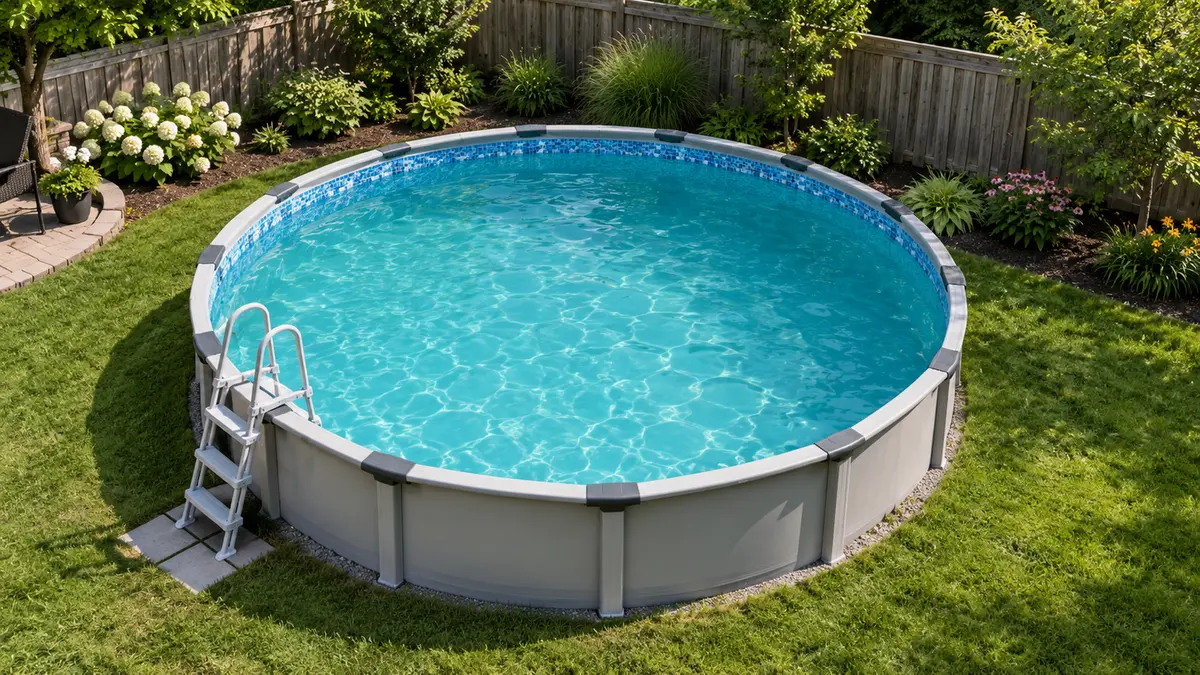
How to use the round pool gallons calculator
Enter the inside diameter and the water depth. If the floor is flat, put the same number in both depth boxes. If the center is deeper than the edge, see the section on dug-out centers below before you enter a deep-end figure. The result shows gallons and liters.
The reference table above lists gallons for 12 to 33 ft round pools at 42, 48 and 52 inches of water, if your pool matches a standard size.
What is the formula for a round pool?
Gallons = diameter² × average depth × 5.9, with diameter and depth in feet. The factor comes from the area of a circle (π ÷ 4 × diameter², or 0.785 × diameter²) multiplied by 7.48 gallons per cubic foot. Exactly, that is 5.875; 5.9 is the rounded shortcut.
The same math written with the radius is the version found in public pool-operator training, such as the Los Angeles County pool service technician’s study guide: radius × radius × 3.14 × average depth × 7.5. Both forms give the same answer to within a fraction of a percent.
Worked example: 24 ft round pool, 4 ft of water
- Diameter squared: 24 × 24 = 576.
- Times depth: 576 × 4 = 2,304.
- Times 5.875: 2,304 × 5.875 = about 13,536 gallons.
- In liters: 13,536 × 3.785 = about 51,241 liters.
With the 5.9 shortcut you get 13,594 gallons, about 0.4% higher. With 4.5 ft of water the same pool holds about 15,228 gallons.
How do I measure the diameter of a round pool?
Run a tape from the inside of the wall, straight through the center, to the inside of the opposite wall at the waterline. The longest measurement you can find across the pool is the diameter. If your tape reads shorter in one direction, you are probably not crossing the exact center.
Practical tips:
- Measure inside the wall, not across the top rail or ledge. Top rails on above-ground pools sit outside the water and add several inches to each side.
- Take two measurements at right angles. This catches a pool that has settled out of round.
- Use the circumference if you cannot reach across. Wrap a tape around the inside of the wall (or the outside, then subtract twice the wall thickness from the diameter) and divide by 3.1416. A 75.4 ft circumference gives 75.4 ÷ 3.1416 = 24.0 ft.
- Check the actual size against the nominal size. A pool sold as a 24 ft round may measure slightly differently inside the wall. Use what your tape says.
What if the center of my round pool is deeper?
Some round pools, especially above-ground pools with expandable liners and round inground pools, are deeper in the middle than at the wall. Here the simple (shallow + deep) ÷ 2 average overstates the water, because a circle has far more area near its edge than near its center.
If the floor slopes evenly from the wall down to a deepest point in the center, like a shallow cone, use this average depth instead:
Average depth = wall depth + (center depth − wall depth) ÷ 3
Worked example: 24 ft round with a dug-out center
The water is 4 ft deep at the wall and 6 ft deep in the center, sloping evenly across the whole floor.
- Average depth: 4 + (6 − 4) ÷ 3 = 4⅔ ft (about 4.67 ft).
- Gallons: 576 × 4⅔ × 5.875 = about 15,792 gallons.
The simple midpoint of 5 ft would give about 16,921 gallons, roughly 7% high. If only the middle of the pool is dug out and the outer ring is flat, take depth readings every couple of feet from the wall to the center and average them, giving more weight to readings near the wall.
Round pool sizes and how depth changes the total
Diameter has a squared effect, so going up one standard size adds a lot of water. At 4 ft of water:
- A 15 ft round pool holds about 5,288 gallons.
- An 18 ft round pool holds about 7,614 gallons.
- A 21 ft round pool holds about 10,364 gallons.
- A 24 ft round pool holds about 13,536 gallons.
Going from 18 ft to 24 ft is only a third wider but holds nearly 78% more water. Depth is linear by comparison: every extra foot of water in a 24 ft pool adds about 3,384 gallons, or about 282 gallons per inch.
Round pool volume in meters
If your pool is sold or measured in meters, skip the 5.9 factor entirely. Liters = 0.785 × diameter² × depth × 1,000, with diameter and depth in meters.
A 7.3 m round pool with 1.2 m of water: 0.785 × 7.3 × 7.3 × 1.2 = about 50.22 m³, or about 50,225 liters (about 13,268 US gallons). That is close to a 24 ft round at 4 ft, which makes sense, since 7.3 m is about 24 ft and 1.2 m is just under 4 ft.
Set the calculator’s units to meters to do this automatically, and keep all three measurements in the same unit. Mixing a diameter in feet with a depth in meters, or depth in centimeters, is an easy way to get a nonsense answer.
Round inground pools
Round inground pools are less common than rectangles, but the method is identical. Measure inside the wall at the waterline and take depth readings at the edge and the deepest point. If the floor slopes from one side to the other rather than toward the center, a straight (shallow + deep) ÷ 2 average works fine.
Many inground pools with curved ends are not true circles. If the length and width differ, the oval or freeform methods on the main pool volume calculator are a better fit.
Common mistakes with round pools
- Using wall height as depth. A 24 ft round entered at 4.5 ft instead of its real 4 ft of water reads about 1,692 gallons high.
- Measuring over the top rail. Even 6 inches extra on each side turns a 24 ft pool into a 25 ft entry, adding over 1,100 gallons at 4 ft deep.
- Measuring off-center. Any chord that misses the center is shorter than the diameter and reads low.
- Averaging wall and center depth on a cone-shaped floor. Use the one-third rule above.
- Squaring the wrong number. Square the diameter, not the circumference or the radius (unless you also switch to the radius formula).