How much does a fiberglass pool cost?
A fiberglass pool costs about $45,000 to $100,000 installed, according to HomeGuide, depending on size, shape, site preparation and upgrades. Fixr reports $50,000 to $95,000 with a $70,000 national average, and This Old House lists a 12 × 24 ft fiberglass pool at $50,000 to $95,000.
| Source | Range | Per sq ft | What the figure describes |
|---|---|---|---|
| HomeGuide | $45,000–$100,000 | $150–$250 (size table) | Installed, varies with size, shape, site prep and upgrades |
| Fixr | $50,000–$95,000 (avg $70,000) | Not stated | Average is a 15 × 30 ft pool with concrete deck, filter, heater and pump |
| This Old House | $50,000–$95,000 | $175–$330 | 12 × 24 ft pool, installation |
The shell model you choose sets much of the price: larger and deeper shells, built-in benches, tanning ledges and spa combinations cost more. The rest comes from the site and the extras around the pool. To compare fiberglass with concrete and vinyl, including fence, decking and heating, use the inground pool cost calculator.
What does the price of a fiberglass pool include?
A fiberglass quote covers the factory shell plus everything needed to set it, plumb it and finish around it. Check that each of these appears in writing.
- The shell. The one-piece pool body, built in a mold with a gelcoat surface.
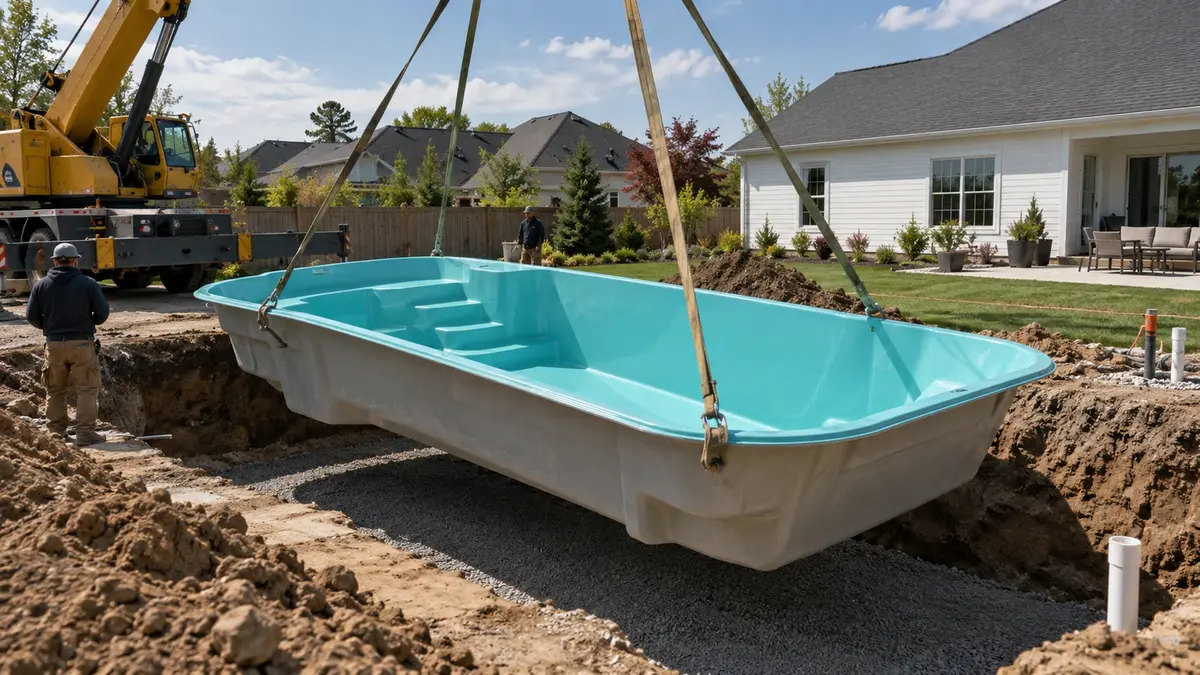
- Delivery and crane. Trucking the shell to your home and lifting it into place.
- Excavation. Digging a hole matched to the shell, plus soil haul-off.
- Base and backfill. A level bed under the shell and backfill around it as it is filled with water.
- Plumbing and equipment. Pump, filter, sanitizer, lines to the equipment pad, and electrical work.
- Coping and deck. The edge cap and the patio around the pool.
- Start-up. First fill and initial water balancing.
Fixr notes that the shell installation itself can be done in a few days. Most of the remaining time goes to plumbing, electrical, backfill, coping and decking.
How long does a fiberglass pool installation take?
Fiberglass is the fastest inground pool to install. HomeAdvisor says fiberglass pools can finish in as little as two to four weeks, and Fixr says order-to-swim takes only a few weeks. By comparison, HomeAdvisor gives four to eight weeks for vinyl and three to six months for concrete.
Two things can stretch the timeline: the wait for your chosen shell to be built and shipped, and local permit review. Ask about both before you sign, especially if you are buying in spring.
Why are fiberglass pool sizes and shapes limited?
Each fiberglass pool is cast in a mold, so you choose from the models a manufacturer makes rather than drawing your own. The finished shell also travels by road in one piece, which caps how wide and long it can be.
For most families this is not a problem, because manufacturers offer rectangles, freeforms, plunge pools and models with built-in seating. It becomes a deal-breaker if you need a very large pool, a deep diving well or a shape fitted to an awkward lot. Those projects suit concrete or vinyl.
Site access matters too. The crane needs room to set up and reach the hole, sometimes over the house. Tight lots can add cost or rule out certain shells.
What does a fiberglass pool cost to own?
Fiberglass is the cheapest inground pool to run. HomeGuide estimates chemicals at about $175 a year for fiberglass, compared with about $400 for vinyl and $750 for concrete, and This Old House puts long-term fiberglass upkeep at $5,000 to $15,000.
Worked example, 10 years of chemicals. Using HomeGuide’s yearly estimates, chemicals for 10 years come to about $1,750 for fiberglass ($175 × 10), $4,000 for vinyl ($400 × 10) and $7,500 for concrete ($750 × 10). The difference comes from the smooth, non-porous gelcoat, which gives algae less to grip and does not push pH up the way curing plaster does.
There is no liner to replace and no plaster to redo. HomeGuide says fiberglass pools last 25 to 30 years but may need refinishing around every 10 years. None of the guides we reviewed publish a consistent price for refinishing, so ask a local installer for one before you compare lifetime costs.
Equipment is the same on every pool type: pumps, filters and heaters wear out on their own schedules. HomeGuide says pool heaters last 10 to 12 years.
What add-ons raise the price of a fiberglass pool?
Heating, covers, lighting and decking are the add-ons that move a fiberglass quote the most. Some are cheaper to include during the build than to retrofit, so decide on them before the shell goes in.
| Add-on | Published cost | Source |
|---|---|---|
| Heat pump, installed | $2,000–$6,000 | HomeGuide |
| Gas heater, installed | $1,500–$4,500 | HomeGuide |
| Saltwater system on a new pool | $500–$3,300 | HomeAdvisor |
| Automatic cover | $8,000–$20,000 | HomeGuide |
| Pool lights | $700–$1,800 | HomeGuide |
| Pool deck | $25–$50 per sq ft | HomeGuide |
Check whether a quote’s headline price already includes any of these. Fixr’s $70,000 average, for example, assumes a concrete deck, filter, heater and pump, while a bare shell-and-install price may not. Matching the scope line by line is the only way to compare two fiberglass bids fairly.
Is fiberglass worth paying more than vinyl?
Fiberglass usually costs more upfront than vinyl but less to keep running, so it tends to pay off the longer you own it. HomeGuide’s ranges put fiberglass at $45,000–$100,000 and vinyl at $25,000–$65,000 installed.
Fiberglass makes sense if:
- You plan to stay in the home for many years.
- You want the lowest chemical use and the least surface maintenance.
- You want a short installation window.
Vinyl or concrete may suit you better if:
- Your upfront budget is tight (vinyl).
- You need a custom size or shape (concrete or vinyl).
- Your yard cannot take a crane or a large delivery truck.
What safety features should be in the budget?
A barrier around the pool belongs in every budget, whatever the pool type. The CDC’s drowning prevention guidance advises a four-sided fence at least four feet high that fully encloses the pool and separates it from the house, with self-closing, self-latching gates. Local codes often require one before final inspection, so price it alongside the pool, not afterward.
To see how many gallons a shell holds, which drives fill cost and chemical doses, enter its length, width and depths in the pool volume calculator.