How to test pool water, step by step
Testing pool water well takes five steps: take the sample correctly, run each test exactly as the kit’s instructions say, read the result in good light, write it down, and compare it with the target range before adding anything. Most errors come from the sample and the reading, not the chemistry.
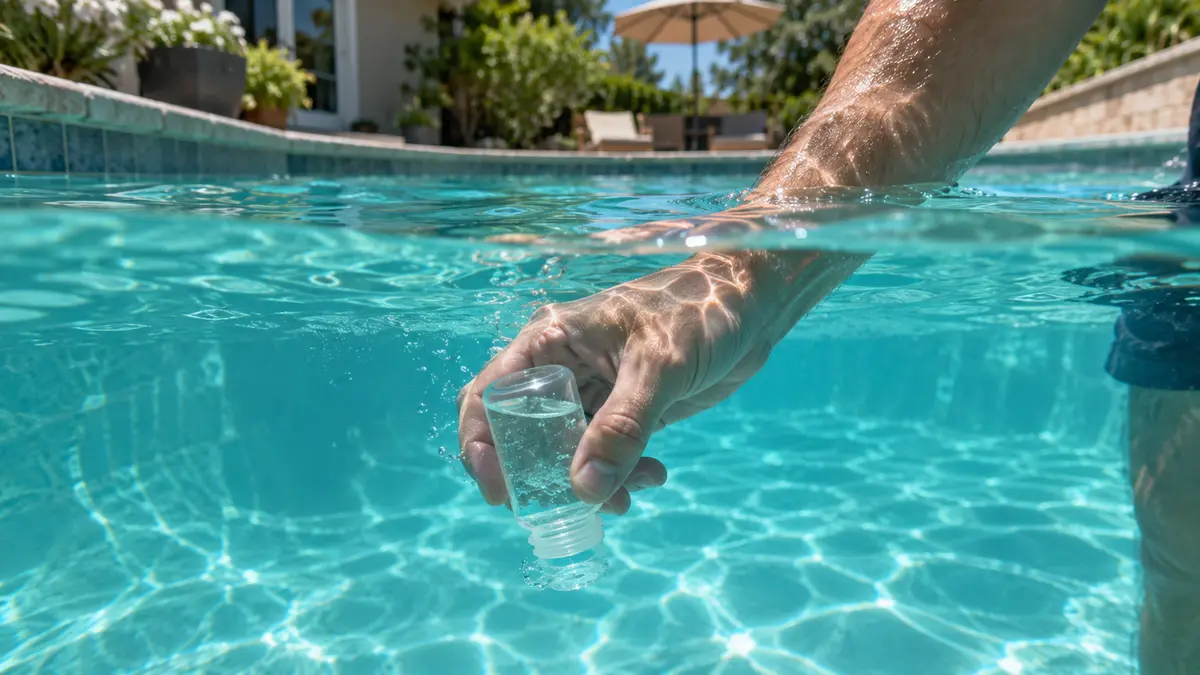
- Collect a sample at elbow depth, away from return jets, skimmers, steps and corners.
- Test immediately, starting with free chlorine, because it changes fastest once the sample is exposed to air.
- Fill each vial to the line, reading from the bottom of the curved water surface.
- Add reagents in the order listed, holding each bottle straight up and down.
- Read colors with the sun at your back, or against the white background the kit provides.
- Log the result with the date, then compare it with the ideal pool water chemistry levels for your pool type.
Which pool test kit should you use?
For most home pools, a FAS-DPD drop kit is the best balance of accuracy, cost per test, and range. Test strips are quick but coarse, OTO and phenol red kits only cover chlorine and pH roughly, and digital photometers remove color judgment but still depend on clean samples and fresh reagents.
| Method | What it measures well | Weak spots | Best use |
|---|---|---|---|
| Test strips | Rough FC, pH, TA, CYA in seconds | Wide color steps; humidity damages the bottle; unreliable at high FC or CYA | Quick checks between full tests |
| OTO + phenol red kit | Total chlorine (yellow) and pH | Cannot separate free from combined chlorine; color fades at high chlorine | Basic pH checks only |
| FAS-DPD drop kit | Free and combined chlorine in 0.5 or 0.2 ppm steps, plus TA, CH, CYA, pH | Takes a few minutes; you must count drops carefully | Routine testing, shocking, troubleshooting |
| Digital photometer | Numeric readout, no color matching | Needs calibration, fresh reagents and clear samples; cloudy water skews readings | Owners who struggle with color matching |
Test strips
Strips are the fastest option and fine for a daily glance, but the CDC notes they are less accurate than DPD test kits. Keep the bottle tightly closed, never touch the pads, dip once, and read at the exact time printed on the label. Reading late is the most common strip mistake.
OTO and phenol red kits
OTO (orthotolidine) turns yellow with chlorine but reads total chlorine, so you cannot tell free from combined. At high levels the color can wash out, so OTO is useless during a shock. Phenol red pH tests are standard in most kits and work well, though very high chlorine can skew the color.
FAS-DPD drop kits
FAS-DPD is a titration: the sample turns pink, and you count drops of reagent until it clears. With a 10 mL sample each drop is typically 0.5 ppm; with a 25 mL sample each drop is 0.2 ppm. Because you count drops instead of matching shades, it stays accurate at 20 or 30 ppm, which plain DPD color tests cannot. It also gives combined chlorine with one extra step.
Digital photometers
A photometer shines light through the reacted sample and displays a number. It removes guessing between two shades, but it still uses reagents with expiry dates, needs clean vials, and reads wrong if the sample is cloudy or has bubbles.
How to take a pool water sample
Take the sample at about elbow depth, roughly 18 inches (45 cm), well away from return jets, and test it straight away. Surface water is affected by sunlight and debris, and water near a return carries freshly added chemicals that do not represent the whole pool.
Taylor Technologies’ sampling guidance describes the technique: use a clean 8–12 oz plastic bottle, push it down upside down, turn it upright at elbow depth to fill, cap it, and begin testing immediately. In a pool with a shallow and a deep end, sample near where the floor starts to slope. Avoid corners, steps and ledges.
For a hot tub or spa, turn off the jets and blowers before sampling.
How often should you test pool water?
Test free chlorine and pH every day or two during swimming season, and daily during heat waves, heavy use, or while shocking. Slower-moving readings need less frequent checks.
| Reading | Swimming season | Also test |
|---|---|---|
| Free chlorine | Every 1–2 days | After storms, parties, heat waves; 3+ times a day while shocking |
| pH | Every 1–2 days | After adding acid or soda ash |
| Combined chlorine | Weekly | When water smells strong or looks dull |
| Total alkalinity | Weekly | After large acid or baking soda doses |
| Calcium hardness | Every 2–4 weeks | After a partial drain or refill |
| Cyanuric acid | Every 2–4 weeks | If you use trichlor or dichlor |
| Salt | Every 2–4 weeks | When the cell reports low salt |
The CDC’s own home-pool guidance is stricter, recommending chlorine and pH checks at least twice a day when the pool is in use. Daily testing is a sensible middle ground for most households.
Common pool testing mistakes
Most bad readings come from a handful of avoidable errors. Fixing these matters more than buying a more expensive kit.
- Expired or heat-damaged reagents. Check the date on every bottle and store the kit indoors.
- Sampling at the surface or near a return. Always sample at elbow depth, away from jets.
- Waiting before testing. Chlorine readings drop once the sample sits in the air.
- Tilting the dropper. Hold bottles vertically so every drop is the same size.
- Covering the vial with a finger. Use the cap; skin contaminates the sample.
- Mixing brands. Reagents are matched to their own instructions and color standards.
- Plain DPD or strips at shock level. Above about 10 ppm, color tests can bleach out and read falsely low or zero.
- Reading in shade or facing the sun. Stand with the sun behind you.
Tips for the CYA turbidity test
The cyanuric acid test turns the sample cloudy; you fill a tube until a black dot on the bottom just disappears, then read the level. It is the test people misread most often.
- Do it outside with the sun at your back, or under bright daylight.
- Look straight down the tube, not at an angle.
- Add the sample slowly near the end and stop the moment the dot vanishes completely.
- If the dot never disappears, CYA is below the scale. If it disappears above the top mark, dilute the sample 1:1 with tap water that contains no stabilizer, retest, and double the result.
- Repeat the test. If the two readings agree, use them; if not, run a third.
Should you take water to a pool store?
A pool store test is useful as a second opinion, but it should not replace testing at home. Store machines often use photometers or strips, results depend on how the sample was collected and how long it sat in a hot car, and the readout usually comes with a product recommendation.
If you go, collect the sample at elbow depth in a clean bottle, cap it, keep it cool, and get it tested within an hour. Ask for the actual numbers, not just a list of products, and compare them with your own readings. To turn the numbers into exact doses, use the pool chemical calculator with your real gallons.
For the bigger picture on routine care, seasonal changes and filling, see the pool water care guide.