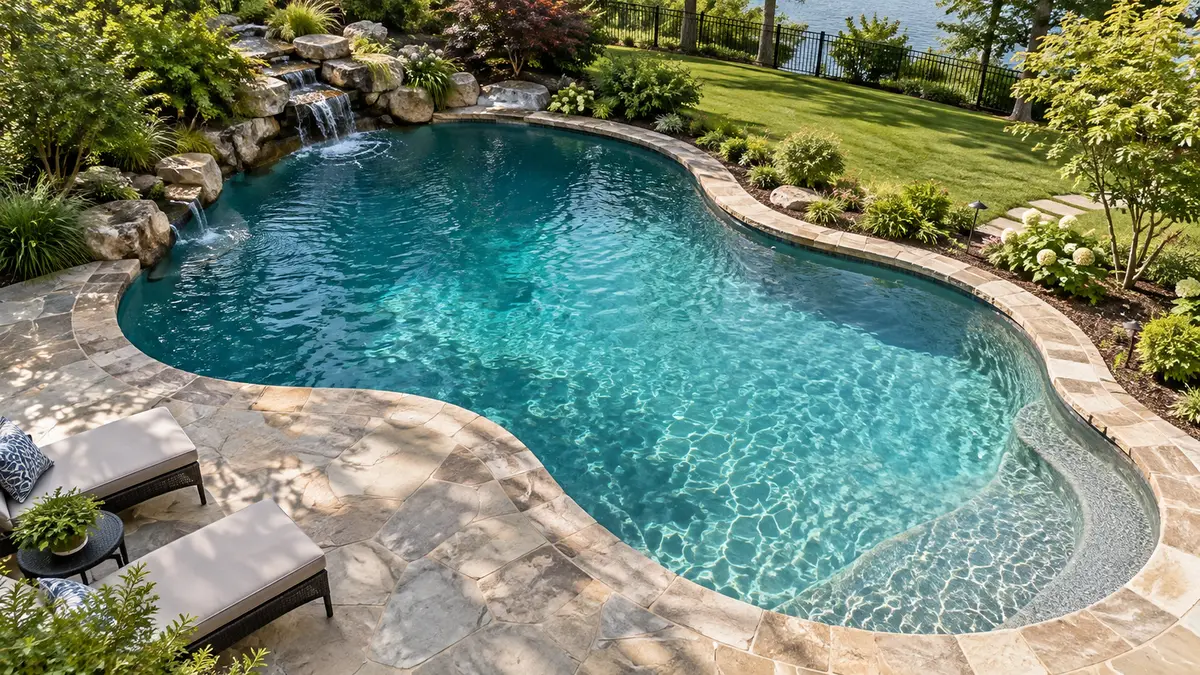
How to use the kidney pool volume calculator
Enter the overall length, Width A (the narrower lobe), Width B (the wider lobe), and the water depth at the shallow and deep ends. The calculator applies the kidney shortcut and returns gallons and liters.
Kidney pools are the most forgiving shape to measure badly and the hardest to measure well. The shortcut gets you close. If your pool is a looser freeform, or if you are about to add salt or stabilizer, use one of the more careful methods further down.
What is the kidney pool formula?
Gallons = 0.45 × (A + B) × length × average depth × 7.48. A and B are the lobe widths, length is the longest dimension end to end, and 7.48 converts cubic feet to US gallons, the figure listed in the USGS water conversion factors.
Why 0.45?
0.45 × (A + B) is the same as 0.9 × the average of the two widths. In plain terms, the formula takes a rectangle as long as the pool and as wide as its average width, then trims about 10% for the curves and the pinched middle. It is a rule of thumb, not geometry, which is why kidney results are estimates.
Worked example: 32 ft kidney pool, lobes 10 ft and 16 ft
The shallow lobe is 3.5 ft deep and the deep lobe is 5.5 ft.
- Average depth: (3.5 + 5.5) ÷ 2 = 4.5 ft.
- Surface area: 0.45 × (10 + 16) × 32 = 0.45 × 26 × 32 = 374.4 sq ft.
- Cubic feet: 374.4 × 4.5 = 1,684.8 cu ft.
- Gallons: 1,684.8 × 7.48 = about 12,603 gallons.
- Liters: 12,603 × 3.785 = about 47,708 liters.
A smaller kidney, 28 ft long with 8 ft and 14 ft lobes averaging 4 ft deep, works out to about 8,294 gallons.
How do I measure a kidney-shaped pool?
Measure inside the wall at the waterline, using the pool’s long axis as your reference line.
- Length: stretch a tape between the two farthest points of the pool. That line is the long axis.
- Width A and Width B: at each lobe, measure the widest distance across, keeping the tape at right angles to the long axis.
- Depth: take readings in the shallow lobe, the deep lobe and the middle.
Two people make this much easier: one holds the zero end, the other walks the tape and keeps it taut. A string line pegged along the long axis helps you keep the width measurements square to it.
Better methods for freeform pools
Freeform pools wander more than a classic kidney, and the 0.45 factor can drift well off. Two methods follow the real outline.
Method 1: split the outline into simple shapes
Sketch the pool from above and divide it into rectangles, circles and half-circles that roughly match the outline. Calculate each piece with its own average depth and add them up.
Worked example. A freeform pool splits into three pieces:
| Section | Size | Average depth | Gallons |
|---|---|---|---|
| Shallow end | 14 × 12 ft | 3.5 ft | about 4,399 |
| Main body | 18 × 14 ft | 5 ft | about 9,425 |
| Narrow arm | 10 × 8 ft | 3 ft | about 1,795 |
| Total | about 15,619 |
Where a curve bulges outside your rectangle, let it cancel against a spot where the rectangle overshoots the curve. Close enough is the goal.
Method 2: width stations along the length
This is the most accurate tape-measure method for irregular shapes.
- Run a string line down the pool’s long axis.
- Every 4 ft along the string, measure the width of the pool straight across.
- Add the widths, counting the first and last ones at half value.
- Multiply that total by the spacing to get the surface area.
- Multiply by average depth × 7.48.
Worked example. A 32 ft freeform pool, measured every 4 ft, gives widths of 6, 11, 13, 12, 11, 14, 16, 15 and 9 ft. Half the end widths (3 + 4.5) plus the seven middle widths (92) is 99.5. Area: 99.5 × 4 = 398 sq ft. At a 4.5 ft average depth: 398 × 4.5 × 7.48 = about 13,398 gallons (50,715 liters).
Closer spacing, such as every 2 ft, improves accuracy on tight curves.
Can I measure a kidney pool from plans or an aerial photo?
Yes, as a starting point. Original construction drawings usually show the outline with dimensions, and many online map tools let you measure distances on aerial imagery. Both give you a length and lobe widths without getting wet.
Treat those numbers as rough. Plans may not match what was built, aerial images can be slightly distorted, and the outline you see from above often includes the coping. Confirm at least the overall length and the two lobe widths with a tape before you dose salt or stabilizer, and always measure depth in the water.
Kidney volume in meters
The formula works the same way in meters, without the 7.48 step: liters = 0.45 × (A + B) × length × average depth × 1,000. A 10 m kidney with lobes of 3 m and 5 m, averaging 1.4 m deep, works out to 0.45 × 8 × 10 × 1.4 = 50.4 m³, or about 50,400 liters (about 13,314 US gallons).
How close is close enough for a freeform pool?
For chlorine and pH, a freeform estimate within 10% is fine, because you dose, circulate and retest anyway. Start with about three-quarters of the calculated dose if you are unsure, then top up after testing.
Salt and stabilizer are different. Both can only be lowered by draining, so an inflated volume estimate can push them past your target. If your pool uses either, confirm the number with the salt-reading cross-check on the main pool volume calculator page, which measures volume from the rise in salt after adding a known weight.
Common mistakes with kidney and freeform pools
- Using a bounding rectangle. A 16 × 32 ft rectangle at 4.5 ft holds about 17,235 gallons, roughly 37% more than the kidney example above.
- Measuring widths at an angle. A diagonal width reads long. Keep the tape square to the long axis.
- Counting a tanning ledge or bench at full depth. Treat shallow features as their own piece.
- Forgetting an attached spa. If the spa spills into the pool and shares its water, calculate it separately and add it.
- Guessing depth. In freeform pools, depth often varies more than the outline does. Take several readings.