How to use the pool chlorine calculator
Enter your pool’s gallons, your current free chlorine, your target, the product you are using and its strength. The calculator returns the amount to add, in fluid ounces for liquids or ounces by weight for granular and tablet products, and notes any stabilizer or calcium the dose adds. Switching the product resets the strength to a typical value (10% liquid, 65% cal-hypo, 56% dichlor, 90% trichlor); change it to match your label.
Choose your target from your stabilizer level, not from a fixed number. The guideline the calculators use puts the minimum at about 7.5% of CYA and the target at about 11.5%. As the Trouble Free Pool explanation of the FC/CYA relationship puts it, a higher CYA leaves a smaller share of chlorine active, so you need more free chlorine to get the same sanitizing power. At CYA 30 the minimum is about 2.3 ppm; at CYA 70 it is about 5.3 ppm.
Not sure of your volume? Get it from the pool volume calculator before dosing.
The chlorine dose formula
For liquid chlorine and bleach:
fl oz = ppm increase × (gallons ÷ 10,000) × (128 ÷ strength %)
For granular and tablet products, by weight:
oz = ppm increase × (gallons ÷ 10,000) × (133.5 ÷ available chlorine %)
The 128 and 133.5 come from converting 1 ppm in 10,000 gallons (about 37.9 grams of chlorine) into fluid ounces or ounces of product. Strength always means available chlorine, the figure printed on the label.
Worked example: raising 15,000 gallons from 1 to 5 ppm
A 15,000-gallon pool reads 1 ppm and the target is 5 ppm, an increase of 4 ppm. Liquid chlorine at 10%: 4 × 1.5 × 12.8 = 76.8 fl oz, a little over half a gallon. Here is the same 4 ppm with each product:
| Product | Dose for +4 ppm in 15,000 gal | Also adds |
|---|---|---|
| Liquid chlorine 10% | 76.8 fl oz | Nothing but a little salt |
| Liquid chlorine 12.5% | 61.4 fl oz | Nothing but a little salt |
| Household bleach 6% | 1 gal (128 fl oz) | Nothing but a little salt |
| Cal-hypo 65% | 12.3 oz | About 2.8 ppm calcium hardness |
| Dichlor 56% | 14.3 oz | About 3.6 ppm CYA |
| Trichlor 90% | 8.9 oz | About 2.4 ppm CYA |
Free, combined and total chlorine: what’s the difference?
Free chlorine (FC) is the chlorine still available to sanitize. Combined chlorine (CC) is chlorine that has already reacted with sweat, urine and other nitrogen compounds into chloramines, which cause the “chlorine smell” and irritate eyes. Total chlorine (TC) is the two added together, so CC = TC − FC.
What that means in practice:
- Dose to free chlorine. It is the number the calculator and the FC/CYA guideline use.
- Watch combined chlorine. Above 0.5 ppm, the pool needs a shock, not a small top-up.
- Use a test that separates them. Most strips and OTO kits read total chlorine only. A DPD or FAS-DPD drop kit reads FC and CC separately.
Which chlorine product should you use?
Every product delivers the same chlorine once it is in the water. The real difference is what is left behind after the chlorine is used up. That side effect builds with every dose, so over a season it decides which product suits your pool.
| Product | Typical strength | Left behind after 100 ppm of chlorine | Effect on pH |
|---|---|---|---|
| Liquid chlorine / bleach | 6–12.5% | Salt only | Raises pH briefly; mostly reverses as chlorine is used |
| Cal-hypo | 65–73% | About 71 ppm calcium hardness | Raises pH |
| Dichlor | 56% | About 91 ppm CYA | Close to neutral |
| Trichlor | 90% | About 61 ppm CYA | Lowers pH and alkalinity |
At 2–4 ppm a day, a pool goes through 100 ppm of chlorine in roughly four to seven weeks, so these numbers add up fast. A pool fed only trichlor tablets that loses 3 ppm a day gains about 55 ppm of CYA in a month. Dichlor is useful for building stabilizer in a new pool, then switch to liquid chlorine before CYA overshoots. Cal-hypo suits plaster pools with low calcium and soft fill water, but it can push hardness into scaling territory over time.
Liquid chlorine is the simplest choice for most pools: it adds nothing that builds up except a little salt, it dissolves instantly, and the dose math is exact.
How much chlorine does a pool need per day?
A sunny, uncovered pool commonly loses 2–4 ppm of free chlorine a day, more with heavy swimming and heat. To find yours, test at dusk and again the next evening, then multiply that loss by your gallons using the formula above.
Examples:
- 15,000 gallons losing 3 ppm a day: 3 × 1.5 × 12.8 = 57.6 fl oz of 10% liquid chlorine daily, or 46.1 fl oz of 12.5%.
- 20,000 gallons losing 3 ppm a day: 3 × 8.34 × 20,000 ÷ 1,000,000 = 0.5 lb of chlorine a day, which is 76.8 fl oz of 10% liquid chlorine.
If daily loss is much higher than 4 ppm in a covered or lightly used pool, CYA is probably too low or something in the water is consuming chlorine.
Why does bleach lose strength over time?
Sodium hypochlorite slowly breaks down into salt and oxygen in the container. Heat speeds that up sharply, and sunlight does too. A jug that left the store at 12.5% can test noticeably weaker after weeks in a hot garage, and household bleach that has sat for months may be well below its printed strength.
That changes your dose. If 12.5% liquid chlorine has dropped to 10%, the amount needed to raise 15,000 gallons by 4 ppm goes from 61.4 fl oz to 76.8 fl oz, 25% more for the same result. To keep doses predictable:
- Buy only what you will use in a few weeks.
- Store jugs in a cool, shaded spot, capped, away from acid.
- Check the manufacture date if one is printed, and choose the freshest stock.
- If doses keep falling short, lower the strength in the calculator and confirm with a retest.
Common chlorine dosing mistakes
- Using total chlorine as free chlorine. A high total reading can hide low free chlorine.
- Setting one target for every pool. 3 ppm is plenty at CYA 30 and too low at CYA 70.
- Dosing in midday sun. Part of the dose is lost before it does its job.
- Ignoring side effects. Months of trichlor or dichlor quietly push CYA up until chlorine stops keeping up.
- Entering the active-ingredient % for trichlor. Use the available chlorine figure, usually 90%.
Chlorine safety
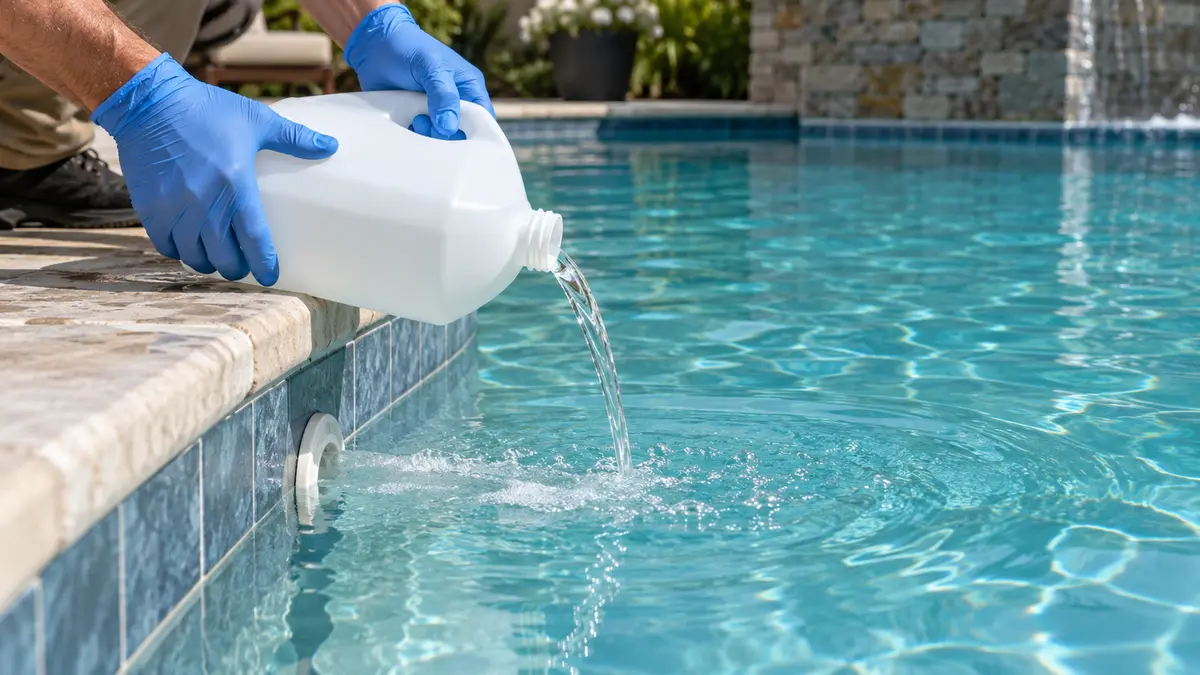
Never mix chlorine with acid or with another chlorine product: chlorine and acid release toxic gas, and cal-hypo and trichlor can react violently. Add chlorine to the pool, never water into a chlorine container. Wear gloves and eye protection, pour slowly near a return jet with the pump running, and wait at least 30 minutes before adding any other chemical. Check every reading together with the pool chemical calculator, and see ideal pool water chemistry levels for the full set of target ranges.